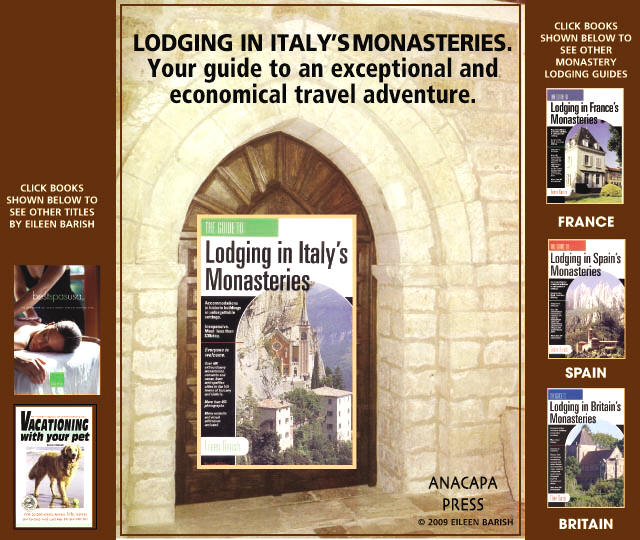
Heavenly Accommodations At Sinfully Low Rates Stay in a beautiful Italian monastery for about 30 euros a day. Open to all without religious obligation. THIS WEBSITE CONTAINS EXCERPTS FROM The Guide To Lodging In Italy's Monasteries The Guide To Lodging in Italy's Monasteries is your passport to over 400 of Italy's monasteries, convents and casas that extend hospitality to guests. It is the only comprehensive source providing easy access to this remarkable travel experience. "Immerse yourself in another time and place. An experience that until now, only a handful of people have enjoyed. "Each monastery represents a singular adventure in an unforgettable setting" Stay in a beautiful monastery for about $30 per day. Perhaps most remarkable is the low cost of the accommodations and meals. The majority of the rates range between a voluntary donation to about $30 per night, often including meals. Open to all without religious obligation. Staying in a monastery, convent or casa is a wonderful travel experience. Everything you need to plan your trip is included: Italian/English reservation letter, contact info, email addresses, costs, amenities, public transportation and driving directions. Eileen Barish is the award-winning author of unique travel guides. Recipient of numerous awards, Eileen Barish's books have been reviewed by over 500 newspapers and periodicals world-wide. UMBRIA The monastery is secluded in a delightfully cool and verdant park, the pretty landscape accentuated by the light that illuminates and softens the terrain. The locale provides spectacular views of the soft edged beauty of the valley below. The building is quite new and has always been open to visitors. In 1235 the convent was erected on this site, an area sacred to the Etruscans. It was then destroyed to build a fortress. In 1448 it once again became a monastery. In the early 19th century a statue representing Mars was found in the convent and is now on exhibit in the Vatican's museum. The 17th century church is enriched with priceless paintings and houses a distinguished library. Nestled in a solitary woodland, the monastery presents a memorable picture. First built in the 14th century, it was enlarged in the 16th with simple and harmonious structures. There is a prized wooden choir in the church but the most important artwork is the Presepe Permanente, created in 1964 by a well known Spanish artist. LIGURIA In 1954 the monks purchased and restored an abandoned 19th century castle adjacent to their monastery and 12th century church. Now an integral part of the complex, the castle is situated amidst a huge park with wonderful views of the sea. Traces of the original church can be seen in the bell tower and apse which serve as the chapel. The casa is annexed to a shrine dedicated to Our Lady. The 16th century church contains frescoes by Niccoló Barnabino as well as a Byzantine painting. A spectacular winding road climbs inland through woodlands to the sanctuary and extraordinary views. Nestled in a superb seaside setting, the luxurious four-star hotel provides all the creature comforts. The beautiful facility was built in the second half of the 19th century by British interests. About a century later, it was sold to a religious foundation for use as a hotel and house for religious practice. VENETO Comprised of three buildings: one was the house of the servants of the Doge and two were 18th century palaces. The complex hosted pilgrims of the 2000 Jubilee. LATIUM The convent and shrine are quartered amidst a woodland with commanding views over the tranquil, verdant valley. The history of the complex began before the 11th century when a chapel was built by Benedictine monks. The land and chapel were bought in order to create a hospice to accommodate the followers of Saint Francis. Typical of many small towns in the region, the convent was built atop a hill as a form of protection from the barbarian invasions. Constructed in 1751, it is enveloped by a beautiful woodland of rare trees (designated as a botanical garden). The vast structure is dedicated to a martyr killed during the Roman persecutions. Despite repeated remodeling during the last two centuries, portions of the original design remain intact. Originally built in 1327, the monastery was later enlarged and remodeled. The main cloister is from the 15th century, its corridors and rooms restored a century later. The neoclassic facade of the church dates from the 18th century. A decade ago during restoration of the parlor, a valuable 14th century fresco was discovered. Although a portion of the fresco did not survive repairs, the art that remains is quite lovely. The monastery is organized around three cloisters: one Renaissance, one early Gothic and the third, considered the most beautiful, is defined by a vaulted ceiling encompassed by a large portico. The architecture of the church is very unusual. The original Gothic facade has been preserved but in 1769, the interiors were completely rebuilt in neoclassic style. A richly endowed library preserves thousands of books, documents and irreplaceable manuscripts. The convent is favored with a hilltop locale above a small ancient town where a recent archeological dig has uncovered Roman ruins. Built in the late 1800s, it was a collaboration of many Italian artists. This blending of talent resulted in establishing the church's identity. It soon became one of the most visited shrines in central Italy. According to the Father Superior, "Everyone wants to get married here. That's all you need to know to understand the beauty and importance of this church." LOMBARDY Quartered in a lakeside position, the guest house was built in the 1960s and replaced a turn-of-the-century villa which belonged to local nobility. The original owners were world travelers and during their travels, they acquired seeds and shrubs that they planted on the grounds. As a result, the guest house is nestled in a large park rich in exotic flora. The villa is well suited for relaxing vacations as well as spiritual retreats. TUSCANY Located in a delightful Tuscan town with Etruscan origins, the historical palace dates from the 13th or 14th century. According to the woman at the desk, "the palace is old and beautiful." Recently renovated, the guest house is open year round. Immersed in its own large park, the monastery was once a 16th century villa which was restored at the beginning of the 1900s. In 1975 a group of monks took up residence. Most came from France and remained until 1991 at which time they returned to their country. The monastery is situated in a region of sunlit corners, quaint churches, rolling countryside and terraced olive groves. Hilltop villages with pastel colored houses are delineated by the ubiquitous cypress that cast their long, slender shadows over the picturesque setting. Ensconced on a panoramic spot, the gracious, elegant villa possesses views of the hills. "The sunsets are beautiful, each so different from the others," said one of the sisters. Built in the late 15th century, the villa belonged to a noble family. In the 19th century it changed hands many times until it once again became the property of a noblewoman. In the early 1960s it was sold to the sisters of the present order. The convent was founded in 1540. Its setting exemplifies the beauty and tranquility of the Tuscan landscape. The ancient structure retains a bright and inviting cloister as well as a number of precious paintings. The monastery was built upon the same caves that the poor used as shelter when St. Francis came to pray in 1211. Originally containing only eight cells, it wasn't until the 16th century that the structure was enlarged to thirty. The monastery, extremely simple and suggestive, represents an example of harmonious integration of architecture and nature. Although it has been restored several times over the years, due to the peculiar position of its buildings, the essence of its medieval atmosphere remains. Situated in a landscape of superlative beauty, the convent is built on the edge of an incredible mile-high stone mountain and is considered a mystical site. In 1213 it was donated to the order by a local count. The chapel was modeled after one in Assisi and was built between 1216 and 1218. Construction of the main basilica was begun in 1358 and completed in 1509. The monastery houses an outstanding collection of glazed terra-cotta works from the Della Robbia School. Founded in the 11th century, the monastery has always been a center dedicated to spirituality and culture. The complex sits amidst a bucolic forest of beech, spruce, chestnut and silver fir, a woodland that has been tended and protected for centuries by the monastic order in residence. The hermitage is encircled by towering trees and thick walls which contain the 17th century church. In 1049 the first monks to occupy the abbey built a hospice and established a pharmacy which remains the heart of the monastery. CAMPANIA The convent and shrine sit atop a hill, ensconced in a cooling tangle of chestnut groves. Perched half a mile above town, the views are spectacular. The complex was founded in 1430 on the same site where three centuries earlier, a shepherd found a statue of the Virgin Mary. The church boasts a magnificent door with Gothic engravings and a cloister embellished with frescoes. The guest house is situated on the panoramic route of the Sorrento Coast. It boasts an incomparable hillside position overlooking the Gulf of Naples. A modern structure, the guest house provides a wide range of comforts and amenities to guests seeking a holiday in this interesting and beautiful area. The convent and shrine are surrounded by verdant hillsides. The original basilica was founded in the 17th century. In 1980 most of the complex was destroyed by an earthquake. The church which opened in 1974 survived the disaster. The convent houses the cell of its patron saint. The grounds contain a museum dedicated to the saint as well as a Pinacoteca (picture gallery) with a display of modern art. FRIULI-VENEZIA GIULIA The convent occupies a small island 5 km from town and is reached by ferry. Built in 582 after the Miracle of the Madonna, it commemorated a wooden statue that appeared on the shores of the island. The statue is considered one of the oldest images of Mary. The interior of the church reveals hundreds of ex-voto (offerings placed as tokens of gratitude), which have been collected over the centuries. BASILICATA Quartered almost a mile above seal level and housed in a new structure, the hotel is annexed to a sanctuary honoring the Virgin. The origins of the shrine date to the 11th and 12th centuries when shepherds found the wooden statue of the Madonna buried atop the mount. TRENTINO-ALTO ADIGE Backdropped by the Dolomites, a unique chain of mountains acclaimed for their stunning panoramas, the convent is blessed with a unique view of the surrounding mountainscapes. "Our oldest guest has been coming here for 63 years. That tells you how beautiful our place is," said the woman at the front desk. The convent was founded in 1553 after a shepherd found a statue of Piety. APULIA At the entrance to the Gargano Peninsula, the enormous convent and shrine dominate a stunningly beautiful spot between two valleys. The peninsula, a blunt, compact promontory jutting into the Adriatic is distinguished by a rolling landscape and terraced slopes. The shrine was first built in the 16th century by Friar Salvatore who began the conversion of the former oratory into the present convent and shrine. SICILY The vast complex is installed in an exceptional hillside position amidst its own spacious park of citrus trees, about a third of a mile above seal level. The abundant citrus crops bloom in late spring and autumn filling the air with an intoxicating fragrance. Perched half a mile above seal level, the sanctuary was built on the outlying hills of a small town. A popular pilgrimage site and active cultural center, it houses a fascinating museum on one of the religious orders. According to legend, the complex was established by a saint before he became pope. First inhabited by Benedictine monks, it was abandoned after a Saracen incursion in the 9th century. A group of hermits tended the shrine from the 12th century until 1535 when they were replaced by the present order. ABRUZZO The present guest house was built in 1932 and restored in 1978. A center for religious conferences, spiritual retreats, it is also an excellent base for excursions into the surrounding mountains. Located in a popular skiing area, the casa is almost a mile above sea level. The convent is idyllically situated at the base of a forested mountain chain, a massif of peaks and valleys often blanketed with wildflowers and pungent herbs. This mountainous region is home to more than forty hermitages and primitive chapels. PIEDMONT The monastery is sited on an appealing spot at the foot of the Sacro Monte mountain path in the center of a small town. The church is the result of the merging of the old church with the new. In the nave connecting the two churches is an impressive fresco composed of twenty-one scenes illustrating the life of Christ. The guest house is nestled in a panoramic position on a hill overlooking the city. It was built thirty-five years ago and then entrusted to an order. Within a short period of time it was converted into a guest house and social/spiritual center. LOMBARDY A monumental complex composed of a boarding school and two churches, it was established in 1576. Nestled in the foothills, the complex is open year-round to guests. The original church has been preserved and a new church was added in the early 1960s. The older church contains a remarkable 16th century altarpiece and a library with an extensive collection of precious books also dating to the 16th century. The college shelters a 17 century globe and houses a recently restored museum of natural history. CALABRIA The convent and shrine are situated half a mile above the sea. The complex was built in 1852 on the site where a wooden picture of the Virgin Mary was discovered in 1301. The icon, revered and worshiped by the local population, was lost over the centuries. In 1550 it was replaced by a painting. Beautifully decorated with marble and frescoes, the church preserves the sacred image. The convent also shelters a library of 30,000 books. MARCHE A relatively new hermitage, it was built in a lovely setting twenty years ago. Only three nuns inhabit the hermitage. Throughout the year they host anyone who wishes to enjoy the peace and silence of the verdant woodland that envelops the eremo. The hotel and restaurant are annexed to an abbey and quartered in a stunning mountain location. Built by Benedictine monks in the 9th century, the gracious stone abbey is quite lovely. According to the present manager, "the Benedictines never built anything at random, this place is full of light. You can see the sun rise and set here. It is full of energy." The Romanesque church contains frescoes and paintings of the Umbro-Marchigiana School. Occupying a charming spot overlooking the Adriatic, the hermitage is on the outskirts of a small town. An enormous yet simple complex, construction began in 1608 and was completed in 1741. The monks were compelled to leave during the Napoleonic and Italian suppressions. They returned sixty years later and have remained since that time. The convent is a beautiful structure totally secluded in the woods yet only a short distance from an appealing medieval town. A dozen monks are currently in residence. Guided tours of the original structure and the 17th and 18th century wings are available to visitors. The church reveals a terra-cotta altar by the Della Robbia School. Spend a night or a week at a monastery and come away filled with the essence of Italy, its history, art, architecture and local traditions Awaken each morning to church bells ringing out over sleepy villages and hill towns. Mingle with the townspeople at the daily market. Inhale the aroma of freshly brewed cappuccino in a friendly cafe. People watch from an atmospheric piazza. Stroll the medieval alleys and cobblestoned Renaissance streets. Admire the centuries-old houses and palaces that stand side by side, as charming today as they were hundreds of years ago. Open to all, regardless of religious denomination, lodging at monasteries is an untouched Italian adventure. A new approach to travel based on a 2,000 year-old tradition of hospitality. Whether you prefer the sophistication of a city or the quaintness of the countryside, each of the hundreds of monasteries described in this guide represents a singular experience in a unique setting. An experience that will linger long after you've returned home. But perhaps most remarkable is the low cost of the accommodations and meals. It is extremely inexpensive to spend the night at a monastery. Rates range from a voluntary donation to about $30 per night. And many monasteries serve meals for just a few dollars more. Others have kitchens and dining rooms where guests may prepare their own food. What is common to each is cleanliness, graciousness, beauty and a sense of unhurried, uncrowded tranquility. Monasteries are an integral part of Italy's history and heritage and symbolize the incredibly diverse Italian culture. Many were built upon Roman and Etruscan ruins. Traces of these distant civilizations remain, contributing to the overall allure of the monastery's setting. Others exemplify the natural beauty of the countryside. The accommodations might be situated beside an alpine lake, backdropped by snow-capped mountains or nestled in a landscape of lush rolling hills strewn with vineyards. You'll find history-laced vignettes and lodging information on monasteries in Rome, Florence and Venice, in the hill towns of Tuscany and Umbria, the famous lake districts of the north, along the Italian Riviera and the Amalfi Coast. Some are in the remote countryside or close to thermal waters and ski resorts. Many were once ancient castles, medieval fortresses, Renaissance palaces or elegant villas. The casas featured are sometimes three-and four-star hotels. They might be secluded in a chestnut forest or installed on a private beach; perhaps perched on a hilltop in a tiny hamlet or a minute's walk from the Ponte Vecchio in Florence or the Spanish Steps in Rome. Monastery, convent, abbey, hermitage, eremo or casa, what's in a name? Historically, monasteries housed monks whereas nuns resided in convents. An abbey was either a monastery headed by an abbot (male) or a convent headed by an abbess (female). A hermitage (eremo in Italian) is just another name for a convent, monastery or private retreat. A casa is a guest house owned and generally managed by an order. Over the centuries, much has changed and the designation of monastery or convent does not necessarily indicate the gender of the order in residence. Monastic orders have traditionally offered hospitality to travelers. This book introduces you to that exceptional travel resource and to a custom that allows you to immerse yourself in another time and place. One that only a handful of people have enjoyed. Staying at a monastery or convent is a rewarding experience but it is important to remember that they are not hotels and should be regarded accordingly. The Guide to Lodging in Italy's Monasteries was researched through personal interviews with each institution. The monasteries described in Section One offer hospitality to all visitors. The information necessary to plan a trip is included: rates, address, telephone, fax (and where available, email address and website), contact person and description of accommodations. A sample reservation letter in Italian and English is also provided. You can book reservations by letter but faxing and telephoning may prove more effective. When calling or faxing, be certain to take into account the time difference and avoid waking someone in the middle of the night. Section Two lists monasteries that offer hospitality to guests wishing to sample the religious life or experience a time of spiritual retreat. All pertinent contact information and special requirements are provided. Monastero-Santuario di Pietraquaria Suore Benedettine di Carità In the heart of the Marsican region, the monastery is dramatically situated atop Monte Salviano Pass, 2/3 of a mile above sea level. After the 1915 earthquake, the ancient town of Avezzano was completely rebuilt along straight, parallel streets and expansive green areas lined with lovely villas. The monastery's name is derived from the medieval city of Pietraquaria which has long since disappeared. A tribe known as the Marsi once inhabited the environs. Noted as wizards and snake charmers, the origins of the modern-day religious festival in the nearby town of Cocullo are attributed to this tribe. The shrine was built in the 19th century and preserves a Byzantine image of Mary worshiped by the local population. "I've lived in several places, but I've never seen such a devotion: it is touching to see how people worship this image. During the month of May, pilgrims walk from Avezzano (7 km) during the night to attend the mass at 5:30 am," said one of the nuns. Although the monastery contains just a few works of art, it offers other treasures, especially those of nature. Long, relaxing saunters in the surrounding woodlands provide a delightful sense of tranquility. Alba Fucens, situated at the foot of Mount Velino, is a few km away. Once a thriving Roman town, the extraordinary archeological site remains an impressive desert of well-preserved white ruins. The 1st century Roman colony includes baths, a villa, theater, basilica and huge amphitheater as well as a milestone marking the ancient Via Tiburtina. Accommodations Guests are hosted in the casa, Domus Mariae: 40 single rooms, some with private baths. Both men and women are welcome. Amenities On request, meals can be offered with lodging. Towels and linens are supplied. There is a conference hall available to guests. Cost per person/per night To be determined, depending on the size of the group, duration of stay and number of meals included. Events The Feast of Madonna di Pietraquaria, complete with Via Crucis and fireworks, occurs at the end of April. In July, there is a beer festival; early August, the Festival of Pasta e Ceci includes folk games and shows; September, a potato festival. Directions By car: Exit at Avezzano on highway A24 or A25 and follow the signs to the monastery. By train: Get off at Avezzano. There is no public transportation to the monastery. Take a taxi or phone the monastery and arrange to be picked up. Contact Madre Superiora Monastero-Santuario di Pietraquaria Località Pietraquaria 67051 Avezzano (AQ) Italy Tel: 0863/35232 Fax: 0863/39291 Oasi di San Francesco d'Assisi Frati Francescani Minori The convent possesses a beguiling setting on the mountains of the Maiella National Park, 2/3 of a mile above sea level. Embodying an almost untamed quality, the heavily wooded landscape is dominated by the Appennines and backdropped by the treeless, snowcapped granite peaks of the Gran Sasso d'Italia. The terrain is sprinkled with looming castles that stand guard over lonely stretches of wilderness. Isolated churches appear here and there in the verdant, hushed countryside. Built in 1978 to promote Franciscan spirituality and culture, the institution represents a Franciscan oasis. Ideally situated for daily excursions, outdoor enthusiasts will appreciate the wildflower meadows and hiking trails of the Parco Nazionale d'Abruzzo, home to the Appennine wolf, Marsican brown bear and other rare wildlife that inhabit the ancient beechwood forests. The convent's Ethnic Museum displays a collection of the most interesting artifacts gathered by the Franciscan friars in their missions around the world. Accommodations 100 guests in single, double and triple rooms (triple rooms can contain up to 4 beds if necessary), each with private bath. Both men and women are welcome. Guests with religious purposes have priority. Amenities All meals are offered with the lodging. Towels and linens are supplied. Cost per person/per night Single room: 37 Euros. Double/triple room: 35 Euros. All meals are included, excluding beverages. Directions By car: Exit at Pratola Peligna or Sulmona on highway A25. Reach Sulmona and follow the signs to Campo di Giove. By train: Get off at Campo di Giove on the local line from Sulmona. The Oasi is a short walk from the train station. Contact June through September contact the Oasi at the address in Campo di Giove. Anyone answering the telephone Oasi di San Francesco d'Assisi Viale San Francesco d'Assisi, 30 67030 Campo di Giove (AQ) Italy Tel: 0864/40394 Fax: 0864/40394 September through May contact Padre Salvatore Zavanelli Direzione Fondazioni Francescane Via Becchetti, 38 06088 Santa Maria degli Angeli (Perugia) Tel: 075/8043769 E-mail: missionifrancescane@libero.it Note: Open June through September. Convento di San Giuliano Frati Francescani Minori A beautiful city in a captivating mountain setting, L'Aquila's landscape is dotted with castles and secluded villages. Surrounded by an atmospheric woodland, the convent occupies a charming hilltop overlooking the ancient town. Convento di San Giuliano was founded by Giovanni da Stroncone in 1415 and was partially rebuilt in the 17th century. Sections of the original structure can be seen inside the complex. The church is Baroque in style and shelters a vast 18th century fresco of the Three Kings. Visitors may enter the main cloister which is adorned with lovely 16th century frescoes. The principal activity of the convent is focused on a small natural history museum divided into four sections: Biology, Mineralogy, Ethnic Art and Paleontology. There is an extensive library which has preserved almost 30,000 books including hundreds of ancient manuscripts, volumes and illuminated works. The town was founded in 1254 by Frederick II of Swabia. He united ninety-nine independent districts, each possessing its own church and square built for the exclusive use of the people living in the ninety-nine castles of the surrounding region. That historical alliance accounts for one of L'Aquila's most interesting monuments, the Fountain of 99 Spouts in Piazza di Porta Rivera. Abruzzo's capital, L'Aquila was named after the eagle (aquilia in Italian) that appears in the imperial coat of arms of Emperor Frederick II. The ancient town is a maze of narrow alleys filled with churches, mansions and romantic squares. Still enveloped by medieval walls, many areas look today as they did hundreds of years ago L'Aquila boasts many wonderful monuments including its perfectly preserved castle, an outstanding 16th century fortress built by the Spaniards. The enormous structure is home to the National Museum of Abruzzo and to an outstanding artifact, the skeleton of a prehistoric elephant. The Basilica di San Bernardino (where the saint is buried), is a fine example of Renaissance harmony; a three-tiered 16th century façade and a carved gilded Baroque ceiling as well as an enameled altar by Andrea della Robbia. The Basilica di Santa Maria di Collemagio is equally impressive. A masterpiece of pure Gothic beauty, the structure is enhanced by rose windows ensconced in pink and white marble, its interior embellished with 14th century frescoes. Accommodations 90 guests can be hosted in double and triple rooms with shared baths. Both men and women are welcome. Note: Hospitality is only offered from mid-June until mid-September and only to groups of twenty or more. The convent books early, make reservations well in advance. Amenities Meals are not offered. Guests may obtain and prepare their own meals in a kitchen at their disposal. Towels and linens are not supplied. Cost per person/per night To be determined, depending on the size of the group. Directions By car: Exit at L'Aquila - Ovest on highway A24 and follow the signs to San Giuliano. By train: Get off at L'Aquila and take a taxi to the convent. Contact Padre Giovanni Convento di San Giuliano Via San Giuliano 67100 L'Aquila (AQ) Italy Tel/Fax: 0862/314201 Abbazia di Santa Maria di Arabona Padri Salesiani/Curia di Chieti The ancient hillside village of Manoppello borders the Pescara River. The abbey is set atop a hill in the midst of a pine woodland. Its history probably dates to the Roman Age as evidenced by a temple dedicated to the goddess Bona. The abbey represents a beautiful example of Cistercian art. It is quite similar to its sister abbeys of Fossanova and Casamari located in Latium. Distinguished by austere Romanesque architecture, the church is rich in precious frescoes and sculptures including the Tabernacle and the Madonna by Antonio da Atri. The refectory, chapter house and dormitory are situated beside the church. In order to maintain the integrity of the site, the entire complex including the garden and its rare botanical species is protected by the Ministry of the Environment. Accommodations The current guest house can host 20 guests in single and double rooms with private baths. A new guest house is under construction. Both men and women are welcome. Amenities Availability of meals, towels and linens will be determined when reservations are made. Cost per person/per night To be determined. Directions By car: From Rome, exit highway A25 at Scafa and follow the signs to Manoppello - Scalo and then follow the signs to the abbey. By train: Get off at Pescara and take the local train to Manoppello. From there, walk up the hill to the abbey (5 minutes) or call the fathers and arrange to be picked up. Contact Arcidiocesi di Chieti e Vasto Piazza Valignani, 4 66100 Chieti Tel: 0871/35911 E-mail: arcidiocesi@diocesichieti.it Website: www.diocesichieti.it Convento - Santuario del Volto Santo Frati Francescani Cappuccini The convent is idyllically situated at the base of the forested Maiella Mountains in Maiella National Park. The Maiella is a massif of peaks and valleys that are often blanketed with wildflowers and pungent herbs. It is home to more than forty hermitages and primitive chapels. The Volto Santo, a sacred image of Christ's face painted on a very fine cloth, is preserved in the convent. According to legend, it was donated by a mysterious traveler to a man who lived in Manoppello. The image was housed in turn by the local families until the Capuchin Friars built the shrine and convent in 1617-20. The friars have inhabited the complex since that time. Both structures were completely restored twenty-five years ago. The Volto Santo is preserved under a glass casket in the church which also shelters a number of 17th century paintings. Accommodations Up to 85 guests can be hosted in the Casa del Pellegrino (Pilgrim's House), in double and triple rooms, each with private bath. Both men and women are welcome. Note: Casa del Pellegrino is scheduled for restoration in 2003 and is usually closed during the winter months but accommodations can be arranged upon request. Call or write in advance. Amenities All meals are offered with the lodging. Towels and linens are supplied. Cost per person/per night To be determined, depending on the size of the group, duration of stay and number of meals included. Directions By car: From Rome, exit highway A25 at Scafa and follow the signs to Manoppello - Scalo and then follow the signs to the convent. By train: Get off at Pescara, take the local train to Manoppello and then walk to the convent. Contact Padre Pietro (or anyone answering the telephone) Convento - Santuario del Volto Santo Località Manoppello 65024 Manoppello (PE) Italy Tel: 085/859118 - 859777 Fax: 085/8590041 E-mail: voltosanto@tiscalinet.it or padregermano@tiscalinet.it Website:www.voltosanto.it Casa per ferie Santa Maria della Croce Serve di Maria Riparatrici The large guest house occupies a hilltop on the outskirts of L'Aquila and envelops the shrine dedicated to Our Lady of the Cross (Madonna della Croce). In the winter months, it hosts students of a nearby engineering faculty, however, guests other than students can also be hosted during the winter. During the summer months (June to September), it is open to all guests. The shrine was built in the 17th century to house a miraculous statue of Our Lady. The statue was found by a shepherd after Mary had helped the man to find his lost flock. The church is very pretty, its interior ornamented with marble. Accommodations 140 beds in single and double rooms and small dorms (5/6 beds), most with private bath. Both men and women are welcome. Amenities All meals are offered with the lodging. Visitors (in groups only) may also choose to prepare their own meals in a kitchen at their disposal. The kitchen is only offered to groups during the summer months. Towels and linens are supplied. In addition to the lodging, there is a conference hall, private parking, soccer field and TV room. Cost per person/per night Lodging: 23 Euros; half pension: 31 Euros; full pension: 37 Euros. Directions By car: Exit at L'Aquila on highway A24 and follow the signs to Poggio di Roio. By train: Get off at L'Aquila and take a bus to Poggio di Roio. Contact Responsabile dell'ospitalità (In charge of hospitality) Casa per ferie Santa Maria della Croce Piazza Santuario 67040 Poggio di Roio (AQ) Italy Tel: 0862/602173 Fax: 0862/602633 E-mail: poggiodiroio@smr.it Website:www.smr.it (The casa does not have its own website but it can be located through this website. The site is in Italian.) Villa Liberata Jesuit Fathers The villa is in a captivating position on the densely wooded Maiella Mountains. High above sea level, it boasts incredible panoramas. Open year-round, the villa is ideally situated for daily excursions to the Maiella Mountains and Mount Amaro. Accommodations 60 beds in 10 small dorms and 2 double rooms, each with a private bath. Both men and women are welcome. Open June through September and the weekend after Christmas. Amenities No meals are offered with the lodging. Guests may obtain and prepare their own meals in a kitchen at their disposal. Towels and linens are not supplied. The grounds contain a chapel, a park with a soccer field and volleyball court. Cost per night 280 Euros per day for entire villa (heating excluded) for groups up to 30 guests. Each extra person is 8 Euros. Directions By car: From Rome, exit highway A25 at Scafa and follow the signs to Manoppello - Scalo and then to Pretorio. Contact For information and reservations, contact by telephone or fax only: Gaetano Terra Tel: 085/4154617 Mobile: 360/385719 Fax: 085/4171096 Villa address: Villa Liberata 66010 Pretorio (CH) Italy Tel: 0871/898356 Casa Madonna delle Rocche Opera Nazionale del Mezzogiorno Parrocchia di Rocca di Mezzo (Parish of Ö) The present guest house was built in 1932 and restored in 1978. It is a center for religious conferences, spiritual retreats as well as an excellent locale for excursions into the surrounding mountains. Rocca di Mezzo is in a popular skiing area, almost a mile above sea level. Accommodations 120 beds in single, double, triple and quadruple rooms, most with private bath. Amenities There is a restaurant where all meals are served to guests. Towels and linens are supplied. Conference halls, TV rooms, private parking, private garden and church are available to guests. Cost per person/per night Full board/single room: 45 Euros. Full board/double room or larger: 40 Euros. Other prices to be determined according to number of meals included. Special prices for groups. Events May: Daffodil Festival, folklore dances and a parade of flowery floats celebrate the arrival of spring. August: Plowing Festival, reenactment of a 17th century custom that culminates with a race to plow the most perfect furrow. Directions By car: Exit at L'Aquila on highway A24 or at Celano on highway A25 and then follow the signs to Rocca di Mezzo. By train: Get off in Rome, Avezzano or L'Aquila and take the bus to Rocca di Mezzo. Daily buses to Rocca di Mezzo leave from the Tiburtina Station in Rome. Contact Don Vincenzo Casa Madonna delle Rocche Via Padre Minozzi 67048 Rocca di Mezzo (AQ) Italy Tel: 0862/917429 Fax: 0862/914858 Aosta Valley Casa Ospitaliera del Gran San Bernardo Canonici Regolari di Sant'Agostino Situated in the Valle d'Aosta, Saint Oyen is a tiny hamlet near the Gran San Bernardo Pass which divides Italy from Switzerland. The pass is dominated by a statue of the saint, patron of mountaineers. There is a quaint parish church in town as well as the resort of St. Rhémy-en-Bosses, a village of Roman origins. The mountainous landscape is carpeted with verdant meadowlands that look like vast emerald seas. The picturesque region encompasses sweeping vistas, mighty boulders, petite waterfalls, secluded hiking trails, crisp alpine air and conifer woodlands. Tiny villages punctuate the mountain slopes while castles, precariously set on high crests, add a note of antiquity. This is the valley of Monte Bianco where awe-inspiring snow-capped peaks loom over the terrain. Rich in history, Hannibal marched his elephants through the area in the 3rd century BC and generations of Roman legions built roads still in evidence today. A castle once occupied the casa's alluring locale on the shores of a serene lake. Founded in the 11th century by St. Bernard of Aosta, the hospice lies just beyond the Swiss border (bring your passport) and is one of the highest inhabited places in Europe. The castle was donated to San Bernardo di Aosta who established a religious community and hospice for travelers crossing the pass. The entire complex was restored in 1991 but its original beauty and simplicity were carefully preserved. The hospice houses an interesting museum and rich library. The Saint Bernard, mascot canine of the region, is a hardy breed of mountain rescue dog that has been trained by the monks since the 11th century. Nearby Aosta is an ancient Roman town whose medieval walls are nearly intact, a city which offers a slice of history combined with artistic and architectural charm. San Orso, the largest medieval complex in Aosta, stands as a tribute to days gone by. The interior of the Gothic Collegiata is festooned with numerous frescoes. Accommodations There are 58 beds. Rooms have from 2 to 6 beds. Most baths are shared. Both men and women are welcome. Amenities All meals are offered with the lodging. Guests can also request a picnic lunch. Towels and linens are supplied upon request for an extra fee of 3 Euros. There is a conference hall, two reading rooms and two meeting rooms that guests may use. Cost per person/per night All meals included: 33 Euros. Lodging only: 11 Euros. Lunch and dinner: 11 Euros each. Directions By car: Exit at Aosta - Est on highway A5 and follow the signs to Passo Gran San Bernardo. The convent is located 18 km from Aosta. By train: Get off at Aosta and take the bus to Gran San Bernardo Pass. Contact Padre Luigi, Responsabile della Casa Casa Ospitaliera del Gran San Bernardo Chateau-Verdun Rue de Flassin, 3 11010 Sant Oyen (AO) Italy Tel: 0165/78247 Fax: 0165/789512 E-mail: klaussarbach@tiscali.it Apulia Monastero di Maria Immacolata Monache Benedettine Celestine The monastery was originally built as a villa in the 17th century by a local family that used it for summer holidays. In 1965, descendants of the family donated the structure to the nuns. At that time, it underwent a period of restoration but the original features have been preserved. Although the works of art are few, the monastery possesses an appealing countryside setting in a peaceful woodland, 1/4 mile above sea level. The town of Castellana Grotte is situated on the edge of an extensive karstic region. Discovered in 1938, the grottoes comprise a series of caves at the bottom of the so-called gravina, a formidable chasm. These caves form the largest and most spectacular speleological complex unearthed in Italy. Consisting of five vast caverns, they are linked by tunnels and corridors and display incredibly shaped stalagmites and stalactites. This particular part of Apulia is renowned for its ancient dwellings called Trulli, cylindrically-based structures with conical roofs made of concentric rings of dried calcareous stones. The dwellings in nearby Alberobello are almost all trulli. In the historic Monti district, there are terraced streets containing over a thousand such buildings. The two-storied Soprano trulli is the highest in town. Even the town's church, Sant'Antonio, blends local neo-Romanesque style with trulli elements. Further examples of the trulli design can be seen in the intricate passageways and quaint alleys of Martina Franca. Accommodations 35 guests can be hosted in rooms containing 3 to 6 beds. Each room has a private bath with a shower. Both men and women are welcome. Amenities No meals are offered with the lodging. Guests may supply and prepare their own meals in a kitchen at their disposal. Towels and linens are not supplied, guests must provide their own. Cost per person/per night Per person in a group: 15 Euros. Per person for individuals: 20 Euros. During the winter, guests are required to give an additional contribution of 10 Euros. Products of the institution The nuns have a book-binding laboratory and restore antique books. Directions By car: 1. Exit at Gioia del Colle on highway A14 and follow the signs to Castellana Grotte. Once in Castellana Grotte, there are signs to Monastero di Maria Immacolata. By car: 2. From Monopoli, take route 377 to Castellana Grotte and follow the signs to Alberobello. Once in Castellana Grotte, there are signs to Monastero di Maria Immacolata. By train: Get off at Bari and take the local train to Castellana Grotte. Once there, call the monastery and arrange to be picked up. Contact Suor Maria Paola Monastero di Maria Immacolata Via Pozzo Stramazzo, 11 70013 Castellana Grotte (BA) Italy Tel: 080/4965516 Monastero di Santa Maria del Piede Monache Domenicane Charmingly positioned in the small town of Gravina, the monastery faces the Cathedral of Santa Maria Assunta. The church was begun in Romanesque style in the early 15th century and eventually completed in Gothic. After sustaining damage in a 1470 fire, the cathedral was rebuilt in Renaissance style. The interior reveals remarkable choir stalls. The rear of the structure offers a beautiful view of ancient Gravina and an atmospheric pine woodland. Monastero di Santa Maria del Piede was established by Duchess Giovanna Frangipane. After the duchess was widowed, she joined the monastic life and funded the construction which began in 1676. The monastery was named after a painting worshiped by the local population, literally meaning Saint Mary of the Foot. A sacred image of Mary was discovered in the foundation ("at the foot") of the new cathedral while under construction. A pretty structure, its interiors are adorned with paintings by De Rosa. "The sun shines all day and we have terraces with a splendid view of the caves of Gravina," said Mother Prior. Gravina owes its name to the deeply-carved gullies which are known as gravina. The ancient city was built in the grottoes in the early Christian period and it is believed that Saint Peter passed through Gravina on his way to Rome. San Michele, a grotto church built in the Byzantine style, is installed in the Rione Fondovico, the oldest part of town. It has a nave and four aisles with pillars. The sanctuary and four apses are all carved in the tufa rock. San Vito Vecchio, another grotto church is in the same area. There is also a castle containing the ruins of a hunting lodge that was once the property of Emperor Frederick II. Accommodations The newly restored guesthouse mainly hosts families seeking peaceful accommodations and small groups for religious use. There are 8 single rooms with 1 bed, each with private bath. Both men and women are welcome. Amenities Meals are not offered with the lodging. Towels and linens are supplied. A reading room, meeting room and garden area are available for use by guests. Cost per person/per night Voluntary contribution. Special Rules Guests must return to the monastery by 8:30 pm. Note: It is recommended that reservations be made well in advance. Directions By car: From Bari, take route 96 past Altamura to Gravina. Once there, look for the sign to the cathedral. By train: Get off at Gravina and take a bus, taxi or walk 2 km to the monastery. Contact Madre Priora or Suor Rita Monastero Santa Maria del Piede Piazza Benedetto XIII, 20 70024 Gravina di Puglia (BA) Italy Tel: 080/3251307 Fax: 080/3251307 Convento - Santuario di San Michele Padri Micaeliti The convent and shrine are nestled in a breathtaking site on the slopes of the Gargano Mountains, close to a half mile above sea level. This isolated mountain ridge town, on the promontory of northern Apulia, is noted for the pristine beauty of its high jagged coastline. The town is a maze of serpentine alleyways where quaint houses jostle against one another in charming confusion. The landscape comprises the Foresta Umbra (Forest of Shadows), a verdant expanse of ancient beech, oak, ilex and pine where stunning vistas of the Adriatic Sea add to the ambience. This is the oldest shrine of Saint Michael and represents one of Italy's most venerated sanctuaries. In 493, the first church was built in a grotto by Bishop Laurentius of Siponto on the same site where the Archangel Michael had appeared to the shepherds. In 1970, it was entrusted to the Benedictine monks of the Abbey of Montevergine in Avellino. This order was later replaced (1996) by the Micaeliti Fathers. The complex is an extraordinary blend of styles including Gothic of Apulia, Romanesque and Baroque. The interior and the stairway leading to the grotto were carved directly out of the rock. The portal, made in Constantinople in 1061, is the oldest surviving door in Apulia. The church contains seven altars including one of Saint Francis and his visit to the shrine. The bishop's throne is made of stone and is the oldest in Apulia. The statue of Saint Michael by Sansovino is on the right side of the church. The crypts are enhanced with reliefs, some Byzantine, some by Acceptus. When visiting the crypts, it is possible to partially retrace the ancient route of the pilgrims to the shrine. The Museo Devozionale is part of the complex and is highlighted by an exhibition of sacred garments, jewels and religious objects. A guided tour of the shrine, museum and crypts can be arranged. Tours are conducted by the Messaggeri di San Michele, a group of young lay guides. Accommodations The newly remodeled guest house located near the shrine has 115 beds in single, double, triple and quadruple rooms - each with a private bath. Both men and women are welcome. Hospitality is available year-round. Amenities All meals are available at the restaurant/cafeteria. Towels and linens are supplied. Guests may use the meeting room, study room and the chapel. Cost per room/per night Provisional cost (subject to change): Single room: 25 Euros. Double room: 40 Euros. Triple room: 55 Euros. Quadruple room: 70 Euros. Breakfast: 2.50 Euros. Lunch or Dinner: 12 Euros. Directions By car: Exit at Foggia on highway A14 and take route 89 to Manfredonia. Follow the signs to Monte Sant'Angelo. By train: Get off at Foggia or Manfredonia and take the local bus to Monte Sant'Angelo (there are more buses from Manfredonia). Contact Casa del Pellegrino (Pilgrim's House) Piazza Carlo d'Angiò 71037 Monta Sant'Angelo (FG) Italy Tel/Fax: 0884/562396 Website: www.santuariosanmichele.it Convento - Santuario di San Michele Via Real Basilica, 121 71037 Monte Sant'Angelo (FG) Italy Tel: 0884/561150 Fax: 0884/561150 Monastero di San Giacomo Maggiore Monache Benedettine Olivetane The monastery is quartered on the outskirts of Palo del Colle. The origins of the monastic center date to 892 when Bishop Giacomo I established a community for the nuns of San Basilio in Bari. In 1344, the nuns joined the Benedictine Order and the congregation of Mount Oliveto. In 1862, as a consequence of Italy's annexation of Bari, there was a suppression of the monastic orders and the nuns' properties were confiscated. They found shelter in a modest dwelling and in 1919, bought the present monastery. The embroidered art of the sisters can be seen in the chapel. "They look like paintings, but they have been painted by our needles," said the Mother Superior. The small town of Palo del Colle is home to a beautiful Romanesque cathedral. Bari, the capital of Apulia, is 10 km from the monastery. Probably of Ilyrian origins, the town has experienced Greek, Roman, Byzantine and Norman rule. It is comprised of two distinct parts. The old district, known as the Città Vecchia is an almost Arabic maze of twisting lanes. The modern town, built to a nearly square plan, stretches inland and along the Adriatic coast. The noteworthy Basilica di San Nicola is sited in the old town. Founded in the 11th century, the relics of the saint are contained in the crypt. Its Norman-styled church became the prototype for many other churches in Apulia. The simple façade is flanked by towers and divided into three sections. The medieval castle, also of Norman heritage (Frederick II), has an assemblage of Romanesque plaster casts of sculpture and architectural fragments. Altamura is also nearby (30 km). Founded in ancient times, it is encircled by walls dating to the 5th century BC. Destroyed by the Saracens in the 9th century, the town was later rebuilt in 1230 by Emperor Frederick II. Its Romanesque cathedral, the only Italian church built by order of Frederick II, is a remarkable building with a fine portal and rose window. Accommodations The guest house has been recently enlarged and remodeled. It has 11 beds in single rooms that can become doubles. Each room has a private bath. Both men and women are welcome. Amenities All meals can be supplied upon request. Towels and linens are provided. A reading/living room is available for guest use. Cost per person/per night Provisional cost, subject to change. Lodging only: 25 Euros. Full board: 40 Euros. Products of the institution The main activity of the nuns is the restoration of gold and silk antique vests commissioned by the Abbey of Montecassino (Latium). They also produce (for domestic sale as well as export) sweets made with Pasta Reale (Royal Pastry). During the summer, they make jam; in the winter, olive oil and more sweets. Events May: Feast of San Nicola, a procession in traditional garb. December: Feast of San Nicola, religious ceremonies and traditional folk celebrations. Special rules Guests are required to be quiet during the evening hours. Directions By car: Exit at Bari or Modugno on highway A14 and take route 96 to Palo del Colle. By train: Get off at Bari and take the train or the local bus to Palo del Colle. From the train station, walk or take a taxi to the monastery. Contact Madre Foresteraria Monastero di San Giacomo Maggiore Via Provinciale per Bitetto, 50 70027 Palo del Colle (BA) Italy Tel: 080/626096 Convento - Santuario Madonna di Stignano Frati Francescani Minori At the entrance to the Gargano Peninsula, the enormous convent and shrine dominate a beautiful spot between two valleys. The peninsula, a blunt, compact promontory jutting into the Adriatic Sea, is distinguished by a rolling landscape and terraced slopes. The region was once a magnificent forest, although little now remains. Traces can be seen in the Aleppo pine woods on the coast, oaks in the valleys and beech trees at the higher elevations. Some of these specimens are extraordinary. One Aleppo, know as Zappino dello Scorzone, is over seven hundred years old and measures six yards in circumference. The convent is one of the stops of the Via Sacra dei Longobardi (Holy Route of the Lombards) that leads to various pilgrimage sites. The shrine was first built in the 16th century by Friar Salvatore Scalzo who began the conversion of the former oratory into the present convent and shrine. The structures were completed in 1613 by the friars who assumed responsibility for the construction and decoration of the complex. For three centuries, the convent represented one of the most important shrines in the area. In 1862, the suppression of the religious orders by the newborn Italian state closed the monastery. In 1953, a donation by a local family enabled the friars to regain ownership of the convent and begin restoration. The church has a rectangular façade. The interiors are adorned with 16th century frescoes painted by the friars who originally built the shrine. The convent was converted into the Oasi Francescana guest house in 1970 and still preserves two pretty cloisters, one of which has a Renaissance well at its center. The location of the convent represents a Franciscan oasis and is ideally situated for outdoor excursions. The surrounding terrain includes the Foresta Umbra, a vast ancient woodland of pine, oak, ilex and birch. Accommodations The newly remodeled Oasi Francescana has a capacity for 100 guests, hosted in rooms with 1-6 beds, all with private bath. Both men and women are welcome. Amenities All meals can be supplied upon request. The price is determined according to the request. There is a large kitchen where guests can prepare their own meals and a large dining room with over 200 seats. Towels and linens are supplied. Cost per person/per night Summer: 15 Euros. Winter with heating: 20 Euros. Events A traditional procession is held on Good Friday. It is celebrated by walking a 5 km route lit by fracchie (wooden torches) made by the locals. The size of the torches range from very small ones made by children to very large ones made by adults. The winner is the person whose torch burns the longest. Special rules Hospitality is only offered to groups of 20 or more. Directions By car: Exit at San Severo on highway A14. Take route 272 to San Marco in Lamis and then follow the signs to Stignano. By train: Get off at San Severo and take a bus to Stignano. The bus stops in front of the shrine. Contact Signora Maria Belardinelli Convento - Santuario Madonna di Stignano Contrada Stignano 71014 San Marco in Lamis (FG) Italy Tel: Main 0882/831033 - (only if necessary 831090) Basilicata Monastero - Santuario Madonna di Picciano Monaci Benedettini Olivetani The monastery and shrine occupy an extraordinary setting on a hillside near Matera. The region is rich in archeological digs, medieval towns, Romanesque churches and Renaissance frescoes. A community of Benedictine monks, members of the congregation of Mount Oliveto in Tuscany, settled here in 1966. The church was built in the 12th or 13th century and was untouched by the earthquakes that plagued the area. On two occasions, however, the bell tower was damaged and not rebuilt. As a result, two small bell towers lean on the façade. The original structure contained just one nave, but 200 years ago, two side aisles were added. The interior shelters a 13th century cross. According to the padre, "The church is simple, with no pretensions and we have a wonderful nature around us." The shrine has easy access to a number of interesting towns. Gravina, in the neighboring region of Apulia owes its name to the deeply-carved gullies which are known as gravina. The ancient city, its churches and dwellings, were built in the grottoes in the early Christian period. Nearby Matera is one of Basilicata's most picturesque cities. Perched on the rocks high above a deep gorge, this ancient town occupies a landscape of denuded valleys and arid rolling hills, a lonely tree here and there adding a touch of greenery to the picture. The origins of the town can be traced to Paleolithic times. It declined under the Greek aegis and then became a Roman colony called Mateola. Destroyed several times as a consequence of the Barbarian, Lombard and Norman invasions, it was rebuilt under Byzantine rule. Matera's unique dwellings, the so-called Sassi are fascinating. There are two Sassi districts, the Barisano and Caveoso. Many of the caves and cathedrals were dug out of the rocks hundreds of years ago by monks. By the 18th century, a number of the buildings had become convents and mansions. In the mid 1900s, the Sassi became a refuge for the poor. It wasn't until Carlo Levi brought attention to the squalid conditions in his book, Christ Stopped at Eboli, that the poverty stricken people were relocated. The caves and surrounding maze of streets remain as local attractions. The Strada Panoramica dei Sasso offers the best view of the caves. Caveoso is the most picturesque district and home to several rock churches including San Pietro, Santa Maria di Idris and Santa Lucia alle Malva, each characterized by Byzantine frescoes. Accommodations Hospitality is offered as follows: 1) For religious use inside the monastery: 50 single rooms and 5 apartments. Each has a private bath. Both men and women are welcome. 2) Families/School/Summer Camp guest quarters in separate building. Schools and families can be hosted in dorms with bunk beds. There are more than 50 beds. Both men and women are welcome. Amenities 1) Inside the monastery: All meals are offered with the lodging. Towels and linens are provided. 2) School/Summer Camp building: Guests must prepare their own meals. Towels and linens are not provided. Note: Both types of hospitality are available year-round. Cost per person/per night To be determined. Products of the institution According to the padre, "The monks enjoy what our brothers make." The monks sell the liqueurs and honey products made at the Abbey of Mount Oliveto in Tuscany. Events Matera, July: A procession of knights and clergyman in costume. Directions By car: Exit at Matera-Nord on route 7 and follow the signs to Gravina and then to the santuario. By train: Get off in Bari and then either take the local train (Apulo-Lucane lines) or the bus to Matera. Once in Matera, take the bus to the santuario. Contact Padre Ospitalario Monastero - Santuario Madonna di Picciano Località Santuario 75020 La Martella (MT) Italy Tel: 0835/302890 - 302899 (ext. 407 for Padre Ospitalario) Fax: 0835/302885 Ostello - Albergo Theotokos Santuario della Madonna di Viggiano Quartered almost a mile above sea level and housed in a new building (1996), the Hostel and Hotel Theotokos are in the ski resort of Viggiano. The hotel is annexed to the Santuario Madonna di Viggiano. The origins of the shrine date to the 11th and 12th centuries when shepherds found the wooden statue of the Madonna buried in a hole at the top of the mount above Viggiano. According to legend, the bishop of Grumentum (a former Roman city), ordered the statue buried to save it from the invading Saracens of the 8th and 9th centuries. These invasions completely destroyed the city. Veneration of the statue grew through the centuries and in 1500, the local population built a chapel atop the mountain to house the sacred object. The statue has dark skin, most likely a reflection of the Basilian monks who lived in the area during the 8th and 9th centuries. The statue consists of the original head mounted on a 17th century wooden body, seated in a regal posture with the child on her lap. The child is richly dressed, his clothes painted in pure gold, also a consequence of the Spanish influence. In the first half of the 18th century, a new basilica was built in the city of Viggiano. The statue occupies two sites: during the winter it remains in the basilica; during the summer, it remains in the chapel. The church is Baroque with an extraordinary wooden ceiling painted in pure gold. On the first Sunday of May, the statue is carried from the basilica to the chapel. This traditional procession includes 50,000 pilgrims and is accompanied by the sound of the zampogne (southern Italian pipes). New church portals by local artist, Marco Santoro, were unveiled in March 1999. Accommodations There are 100 beds in single, double and quadruple rooms, with private baths and 3 dorms (12 beds), 2 of which have private baths. There are 2 choices. Albergo Theotokos: Single visitors, families or small groups are hosted by the two-star Albergo. All meals are offered with the lodging. Towels and linens are supplied. A telephone and TV are provided in each room. Ostello: Groups of 50 or more, single visitors or families can stay in the hostel. Guests may choose to frequent the restaurant which offers breakfast, lunch and dinner; or to supply their own food, plates, glasses and cutlery and have their meals prepared, but not served, by a cook of the hostel. Towels and linens are not supplied. Amenities The grounds contain a soccer field and volleyball court in a large park area. Cost per room/per night (Hotel Theotokos) Single room : Breakfast and linens included: 21 Euros. Double room : Breakfast and linens included: 31 Euros. Triple room : Breakfast and linens included: 42 Euros. Quadruple room: Breakfast and linens included: 52 Euros. Cost per person/per night (Hostel): Lodging and meals to be determined according to size of the group. Events September: The shrine organizes flute and harp concerts. Directions By car: Exit at Atena Lucana on highway A3 and take route 598 south. Turn on route 276 to Viggiano. By train: Get off in Potenza and take the bus to Viggiano. Contact Anyone answering the telephone Ostello - Albergo Theotokos Piazza Papa Giovanni XXIII 85059 Viggiano (PZ) Italy Tel: 0975/61409 Fax: 0975/61523 E-mail: ostellotheotokos@tiscali.it Calabria Istituto Suore di San Giovanni Battista Suore di San Giovanni Battista (Battistine) The istituto is in Cetraro, an ancient city once named Citrarium, derived from the abundant citrus groves in the area. The entire complex, including the former convent and the 13th century church, have been repeatedly altered. However, an interesting 15th century marble triptych is preserved in the church. The Battistine sisters have turned the convent into a guest house. It is ensconced in a panoramic setting overlooking the sea and surrounded by olive groves, 1 km from the town of Marina di Cetraro and its beaches. The nearby town of Paola extends over a shelf on the coastal mountains above a stretch of shoreline. It is famous as the birthplace of Saint Francis, founder of the Minim Order. The Santuario di San Francesco occupies an isolated site in a river gorge. Built in the 15th century, it is a large complex of Renaissance and Baroque buildings. Its church boasts a fine portal and ogive (a diagonal arch across a Gothic vault). The chapel holds the saint's relics. The cloister, distinguished by Gothic and Renaissance arches, is ornamented with frescoes. Accommodations 23 beds in single, double and triple rooms with private baths. Amenities All meals are offered with the lodging. Towels and linens are supplied. There is a garden and a living room. Punctuality at meals is expected. Cost per person/per night To be determined, depending on the size of the group, duration of stay, number of meals included and season of the year. Directions By car: Cetraro is on the hill right above the west coast of Calabria. It can be reached by Strada Statale 18 (SS 18). By train: Get off at Paola and then change trains to the local line to Cetraro. From there take a taxi to the convent, (public transportation is difficult). Contact Madre Superiora Istituto Suore di San Giovanni Battista Via Ritiro, 10 87022 Cetraro (CS) Italy Tel: 0982/91024 Convento - Santuario Madonna della Catena Padri Passionisti The convent is situated a half mile above the Tyrrhenian Sea in the hills of Laurignano, a small town of the Cosenza province. The convent and shrine were built in 1852 by Friar Benedetto Falcone on the site where a wooden picture of Virgin Mary was discovered in 1301. The icon of Virgin Mary, revered and worshiped by the local population, was lost over the centuries. In 1550, the icon was replaced by a painting. In 1906, the Passionist Fathers took up residence in the complex and in 1942, built a new church on the grounds. Beautifully decorated with marble and frescoes by Lucillo Grassi di Storo, the church preserves the sacred image of the Virgin Mary. The convent houses a well-stocked library of 30,000 books. Accommodations 50 beds in single and double rooms, each with a private bath. Both men and women are welcome. Amenities All meals are included with the lodging. Towels and linens are supplied. Cost per person/per night Provisional cost 30 Euros, all meals included (or voluntary contribution). Directions By car: Exit at Cosenza and take route 278 to Dipignano/Laurignano. By train: Get off at Cosenza, take a city bus to the Autostazione (bus station) and then take the bus to Laurignano. Buses do not run on Sundays. Contact Padre Superiore Convento - Santuario Madonna della Catena Via Santuario 87040 Laurignano di Dipignano (CS) Italy Tel: 0984/445889 - 445193 Fax: 0984/445769 Website: www.passionisti-laurignano.it Convento - Santuario di San Francesco di Paola Frati Minimi Paola is the birthplace of Francesco d'Alessio, known as San Francesco di Paola (1416 - 1507), founder of the Mendicant Order of the Minims and Patron Saint of Italian seamen and of Calabria. In 1467, he established the first religious community and church. Some of his friars accompanied Columbus on the first journey to America. Some became bishops of Latin America cities. During the Napoleonic suppressions of the monastic orders, the convent was turned into barracks and then into a boarding school. The friars returned in 1901 and restored not only the monastic life but the structures of the church and convent as well. The shrine is very peculiar: its façade is in two distinct architectural styles, Renaissance and Baroque. It is adorned with a fine 15th century portal by Tommaso Gismondi. The asymmetric interiors contain a monumental organ which has 4,500 pipes and 84 tunes. The interior of the convent possesses a 15th-16th century cloister with late-Gothic and Renaissance vaults and a corridor with frescoed wooden ceilings. The library has preserved thousands of precious documents and books. There is also a museum containing numerous paintings including the 17th century Ecce Homo by Mattia Preti. Accommodations 1. Hotel San Francesco - Casa del Pellegrino: 110 beds in 43 double and triple rooms, all with private bath. Towels and linens are supplied. 2. Hostel: This guest house is reserved for young scouts or groups of younger pilgrims. Guests are hosted in 2 dorms with 25 beds each. Towels and linens are not supplied. 3. Hospitality in the convent is reserved for religious representatives or those seeking spiritual retreats. Amenities 1. Hotel San Francesco: all meals can be supplied on request. The hotel also provides a meeting room with TV. 2. Hostel: no meals are offered with the lodging. Visitors may obtain and prepare their own food in the kitchen at their disposal. Towels and linens are not supplied. 2. Inside the convent: all meals are offered with the lodging. Towels and linens are supplied. Cost per person/per night Full board: 36 Euros. Half board: 32 Euros. Lodging only: 25 Euros. Lunch only: 11 Euros. Other prices to be determined according to the number of meals included with lodging. Special discount for large groups of 25 or more. Events The convent organizes concerts using the church's organ for performances. Note: Accommodations book quickly. Call or write well in advance. Directions By car: From Rome, exit at Lagonegro on highway Napoli - Reggio Calabria and take Strada Statale 107 (SS 107) to Paola. The convent and shrine are located 2 km from the center of the town. By train: Get off at Paola and take a bus or a taxi to the convent. Contact Hotel San Francesco - Casa del Pellegrino Via Timpa, 3 87027 Paola - Santuario (CS), Italy Tel: 0982/611457 - 6254117 Fax: 0982/611457 Built as a memorial of the Holy Year 1950, the obelisk is approximately 75' tall. There are two bronze panels by Biancini that portray the saint crossing the Strait of Messina and the saint as the Protector of Calabria. Convento - Santuario di San Francesco di Paola Frati Minimi San Francesco di Paola personally established the complex in 1444. Drawn by the solitude it offered, Saint Francis chose the complex as his permanent residence. At the time, it was more isolated than the Santuario di San Francesco di Paola, also founded by the saint. Surrounded by its own park, the convent's site is nearly half a mile above sea level. The complex is composed of various buildings which encircle the central cloister. In the center of the large hall, there are two rows of octagonal Corinthian pillars connected by arches and vaults decorated with arabesques. The façade of the church is quite lovely, adorned with an arcade of four arches and a round portal. The interiors are in Baroque style, the walls ornamented with 15th century frescoes created by local artists. Paterno has easy access to the Tyrrhenian Sea and the National Park of Sila. Accommodations 50 single, double and triple rooms. Double and triple rooms have private baths, the rest are shared. Both men and women are welcome. Hospitality is offered only to groups of 30 or more and only during the summer months. Amenities No meals are offered with lodging. Guests may prepare their own food in a kitchen at their disposal. There are also a number of restaurants nearby. Towels and linens are not supplied. Cost per person/per night 7 Euros. Directions By car: Exit at Rogliano - Piano Lago (south of Cosenza) on the Salerno - Reggio Calabria highway and follow signs (12 km )to Paterno Calabro. By train: Get off in Cosenza and take the bus to Paterno Calabro. It stops near the convent. Contact Padre Superiore Convento - Santuario di San Francesco di Paola Piazza San Francesco, 6 87040 Paterno Calabro (CS) Italy Tel/Fax: 0984/476032 E-mail: santuariopaterno@libero.it Convento - Santuario di San Domenico Frati Domenicani The convent and shrine are ensconced on a hillside overlooking the plains formed by the Mesima River. Founded in 1510, the convent was one of Europe's most important shrines. "It was what Lourdes is today," said the Father Prior. It owed its fame to a miraculous image of Saint Dominique which has been preserved since 1530. According to legend, the painting was donated by Mary to Friar Lorenzo da Grotteria to replace the simple image over the altar of the church. In 1559, an earthquake ravaged the complex but it was rebuilt and enlarged. By 1600, the shrine was visited by 200,000 people each year. A second earthquake in 1783 once again caused severe damage. Restoration has never been completed. In 1866, the monastic suppression forced the friars to leave. The convent was abandoned for almost 80 years. The complex now encompasses the convent and the new shrine which is situated higher on the hill than the old one. The remnants of the ancient shrine are still used. The friars organize summer concerts and exhibitions in the roofless "amphitheater." Although most of the art was lost during the earthquakes, some remains, including a 17th century wooden choir, paintings by the Neapolitan school, sculptures of the Caravaggio school and a bust by Bernini. Soriano is renowned for its mostaccioli, a typical sweet pastry of Calabria. Legend says that the friars of the shrine originally had the recipe, but that over the years the making of the pastry became the province of the town. Accommodations A new guest house is under construction. Guests are invited to fax the convent to see if hospitality is available. Amenities No meals are offered with the lodging. Guests must obtain their own meals outside the convent (there are several small restaurants nearby). Towels and linens are supplied on request. Cost per person/per night To be determined, depending on the size of the group and duration of stay. Special rules Guests are requested to return to the convent by 9:30 pm. Directions By car: Exit at Le Serre on highway Napoli - Reggio Calabria and follow the signs to Soriano (10 km). By train: Get off at Vibo Marina, take a bus to Vibo Valentia and from there, take a bus to Soriano. Since public transportation to Soriano can be difficult, the friars recommend taking a taxi from Vibo Marina. Contact Priore Convento - Santuario di San Domenico 89831 Soriano Calabro (VV) Italy Tel: 0963/351022 Fax: 0963/351022 Campania Monastero di San Biagio Monache Benedettine di San Biagio Founded by the Normans in 1030, Aversa became the center of the Norman fiefdom. It was the home town of well-known composer Domenico Cimarosa. There are three monuments worthy of mention: the 11th century cathedral, the Church of the Annunziata and the Church of San Francesco. Located on the outskirts of town, the monastery complex is built beside a castle and is partially surrounded by high walls and a moat. For the most part, the architecture of the church is Romanesque in style. It has an elaborate façade with three portals, twelve chapels and a cloister on the lower floor of the monastery. It flourished until the suppression of the monastic orders in the 19th century. Although most of the artwork was confiscated during the suppressions, the nuns never left the monastery. Until the Reggia (Royal Palace) was built in 1752, the nearby city of Caserta was an insignificant village. The Royal Palace is designed along the lines of Versailles. It is an immense five-story structure covering an area of 474,000 square feet with 1,790 windows, over 1,200 lavishly decorated rooms and numerous grand staircases. The grandest of all, the majestic main staircase, contains 116 steps carved from one gigantic block of stone, resulting in a rich combination of marbles and dramatic perspectives. The stairway leads to the glorious apartments comprised of 25 rooms. There is also a gem-like theater modeled after San Carlo. Designed by Luigi Vanvitelli for King Charles III of Naples, the palace was the last great building in the Italian Baroque style. The gardens are elaborate affairs covering hundreds of acres. Perhaps the loveliest are the English Gardens which showcase a tiny lake and fake ancient ruins. The grounds also contain a castle built as a playhouse for the Bourbon princes. S. Maria Capua Vetere and its Roman remains are close to Caserta. The 1st century AD amphitheater is extraordinary and only slightly smaller than the Colosseum in Rome. The Temple Miathreum, dedicated to the god Mithras, is part of the ruins. Accommodations There are two options: 1. On the grounds of the monastery: a small apartment with a room containing 4 beds and a bath. Both men and women are welcome. 2. The guest house inside the monastery: 10 beds in single and double rooms, each with private bath. Both men and women are welcome. Amenities Visitors in the guest house may obtain and prepare their own meals in in the apartment's kitchen. Towels and linens are supplied. The guest house inside the monastery also has a kitchen for guest use. Note: Private parking is provided. Cost per person/per night To be determined. Products of the institution The nuns make pottery, cushions and paint. Events Caserta: Throughout the year, concerts take place at the Royal Palace. January: Festival of San Sebastiano. Directions By car: Exit at Napoli - Nord and follow the signs to Aversa and then to the monastery. By train: Get off at Napoli or Caserta and take the local train to Aversa. From the train station, walk (15 minutes) or take a taxi to the monastery. Contact Madre Abbadessa Monastero di San Biagio Via San Biagio, 35 81031 Aversa (CE) Italy Tel: 081/5045712 - 5039569 Fax: 081/8901462 Convento - Santuario Maria Santissima di Carpignano Santa Maria della Mercede (Mercedari) The convent and shrine are perched on a hill in a peaceful and panoramic position in the city of Carpignano. The origins of the complex date to the 12th century when a young shepherd found a painting of Our Lady on the hillside. The image became very famous and eventually a church was built to house it. Due to a number of earthquakes over the centuries, the structures suffered a period of neglect. In 1859, the complex was rebuilt, fulfilling a vow made by the town's inhabitants. Although the complex was damaged during World War II and again by an earthquake in 1980, the buildings were restored in 1990. The church shelters an ancient painting of the Madonna di Carpignano. Accommodations The guest house has become a Casa di Esercizi Spirituali, but it can also host groups of pilgrims. There are 65 beds in single, double, triple and quadruple rooms, each with a private bath. Both men and women are welcome. Hospitality is reserved to groups of 40 or more. Amenities Meals can be offered on request. Visitors have a kitchen and dining room at their disposal. Towels and linens are supplied upon request. The complex has conference halls, sport facilities, a playground and garden. Cost per person/per night The basic cost per person is 10 Euros, heating and linens excluded. Additional costs to be determined upon arrival. Directions By car: Exit at Grottaminarda on highway A16 and follow the signs to Carpignano (4 km). By train: Get off in Rome and then take the bus (Marozzi line) from the Tiburtina Station to Grottaminarda. Once in Grottaminarda, take the local bus to Carpignano. Contact Responsabile dell'Ospitalità Convento - Santuario Maria Santissima di Carpignano 83030 Carpignano (AV) Italy Tel: 0825/441359 Fax: 0825/426842 E-mail: carpignano@freemail.it Istituto Salesiano San Michele Società Salesiana di Don Bosco (Salesiani) The Istituto Salesiano San Michele is a guest house located at the start of the panoramic route along the Sorrento Coast. It occupies an incomparable hillside position overlooking the Gulf of Naples. A modern structure, the guest house provides a wide range of comforts and amenities to guests seeking a holiday in this interesting area. Castellammare and the Istituto San Michele are close to some of Italy's famous sites. Naples, Pompeii, Ercolano and the Amalfi Coast are all within a half hour, either by car or Vesuviana, the local train, The train connects Naples to Sorrento and stops in Castellammare di Stabia, Ercolano and Pompeii. Mount Faito, situated over a mile above sea level, is accessible by cable car from Castellammare. Its apex offers breathtaking vistas of the environs. Nearby Pompeii (8 km) lies at the foot of Mount Vesuvius. When Vesuvius erupted in 79 AD, the town was destroyed and completely buried in molten lava, its ashes reaching as far as Africa. It wasn't until the 17th century that the ancient city was rediscovered. Excavations have revealed many buildings and artifacts that reflect a lifestyle more than two thousand years old. An abundance of stone pine trees distinguish the surrounding area. First introduced in Roman times, the trees are noted for their umbrella-shaped crown of foliage. Accommodations 160 beds in rooms with 1 to 6 beds and 1 apartment with 8 beds. Each room has a private bath. Amenities All meals are offered with the lodging. Guests have a choice of lodging without meals to full board. Towels and linens are supplied. The guest house has a large sports-oriented playground including volleyball, basketball and soccer fields. As with all traditional Salesiani Institutes, there is a well-equipped conference hall, two chapels, TV rooms, a church, theater, library and laundry service. Cost per person/per night Costs vary according to the season, type of room, number of meals included and size of the group. Provisional costs subject to change. Double room: Lodging only: 26 Euros to 29 Euros. Half pension: 32 Euros to 34 Euros. Full pension: 37 Euros to 40 Euros. Additional charge for single room: 5 Euros. Directions By car: Exit at Castellammare di Stabia on highway A3 and then follow the signs to the city. By train: Get off in Naples and take the local line, Vesuviana, which connects Naples to Sorrento and stops at Castellammare. The istituto is a five-minute walk from town. Contact Reception Istituto Salesiano San Michele Via Salario, 12 80053 Castellammare di Stabia (NA) Italy Tel: 081/8717114 / Fax: 081/8715260 E-mail: cmareime@pcn.net Website: www.salesiani-meridione.pcn.net Amalfi Coast For centuries, the beauty of the Amalfi Coast, thirty miles of lemon-scented Mediterranean splendor, has captivated the imagination and won the hearts of travelers. The islands in the Bay of Naples sparkle like jewels, their sandy beaches and clear blue waters an invitation to summer fun. Campania's ancient history is tied to the Etruscans and the Greeks, evidenced by the enormous ruins of Paestum as well as the small towns and villages scattered throughout the secluded and often overlooked mountainous interior. Amalfi Carved into the Lattari Mountains at the edge of the sea, Amalfi extends over a steep slope along the coastline, its white Mediterranean-style dwellings burrowed in cliffsides. Legend has it that Hercules chose this site for his beloved nymph Amalfi because the color of her eyes and the sea were identical. The town's most remarkable structure is undoubtedly the cathedral dedicated to Sant'Andrea which sits atop a spectacular flight of steps. The Moorish influence is most notable in the bell tower and the Cloister of Paradise, burial place of some of the town's most notable citizens. Outdoor excursions await on the trails and stairways honeycombing the hills above Amalfi. These pathways connect with mountainside villages and provide a delightful venue into nature. The Valle Dei Mulini hiking trail passes the ruins of nearly a dozen paper mills. Conca Dei Marini Situated along the winding ribbon of coastline, the houses of this quaint village scale the mountainsides. The Grotta di Smeraldo, discovered by a fisherman in 1932, offers a mesmerizing vision of bizarre stalactites and stalagmites backdropped by the alluring emerald sea. Minori Nestled within a crook of the coastline and guarded by characteristic watch towers, Minori boasts a delightful little beach. The town's large Roman villa is notable for its architecture and ensemble of finely preserved paintings and mosaics. Palinuro This small village stretches out towards the sea, a promontory dividing two beaches. The coastline is a collection of glistening caves where recent excavations have revealed an archaic necropolis. Positano Positano's origins are unclear but more than likely it was founded by fugitives from Paestum. Snuggled in a cove, its winsome houses of yellow and ochre, orange and pink, tumble down the steep and verdant hillside to the sea. Famous for an air of elegant simplicity, it is undoubtedly the most picturesque town of the Amalfi Coast. Characterized by a Moorish appearance, the charming façades add to the inviting atmosphere. The majolica-domed church of Santa Maria Assunta dominates the boat-lined beach. Positano is crisscrossed with a maze of steps and arcaded passageways climbing steeply from the shore towards the mountains. Ravello Ravello's rich vegetation, magical landscape and Arab-Sicilian edifices create an unforgettable vision. Perched high on a shelf above Amalfi, the town offers views possessing an almost dreamlike allure, particularly from the lush gardens of Villa Rufolo and Villa Cimbrone. Embellished with arches in Arab-Sicilian style, the shaded grounds of the Villa Rufolo provide a distinct sense of serenity. Views from the Belvedere of Infinity encompass the chalky white cliffs, fluttering sails and sparkling azure blue sea all the way to Paestum. Salerno Cradled between the enchantments of Amalfi and the unforgettable beauty of Paestum, Salerno is a place of beaches and bright busy streets, its seaside gardens luxuriant with greenery, the waters along its shore a shimmering blue. Probably of Etruscan origin, Salerno was a Roman colony in 197 BC. Conquered many times throughout the years, Norman ruler, Robert Guiscard made Salerno the capital of his dominion and founded the Scuola Medica Salernitana. The city is comprised of three distinct districts. The medieval core is quartered on the slopes behind the coast and is defined by narrow winding streets. The 18th century area lies beyond the old walls. The third section is the modern town, built after WWII. Important monuments include the 11th century duomo built by Robert Guiscard and a Romanesque campanile which shelters two extraordinary mosaic pulpits from the 12th and 13th centuries. The Teatro Verdi is a neoclassical building boasting a beautiful drop curtain by Morelli. Convento Santuario di San Gerardo Maiella Padri Redentoristi The convent and shrine are surrounded by the green hills of Irpinia. The original basilica was founded in the 17th century by Sant'Alfonso Maria de' Liguori. In 1980, it was completely destroyed by an earthquake. The new church which opened in 1974 survived the disaster. The convent houses the cell of the patron saint, San Gerardo Maiella. The grounds contain a museum dedicated to the saint as well as a Pinacoteca (picture gallery) with a display of modern art. "All of Caposele and Materdomini life revolves around the convent and the shrine," said the father. "In the summer, it gets very crowded and there are celebrations on October 16th, San Gerardo's Day." Despite being plagued by terrible earthquakes (much of the town was destroyed in the 1980 earthquake), nearby Avellino has remained an important city throughout many historic periods. Situated in a wide green valley in the ancient Irpinia uplands, the town began as a Roman colony and flourished again in the Middle Ages. The investiture of Roger the Norman as King of Sicily took place in Avellino in 1130. Important monuments include the Cathedral of Santa Maria Assunta, the Romanesque duomo, the medieval Palazzo della Dogana and the 17th century Palazzo Caracciolo. The Museo Irpino exhibits archeological relics from prehistoric times through the Roman era. Accommodations The Hotel San Gerardo has been recently remodeled and is now a 3-star hotel: 80 rooms (single, double and suites), each with a private bath. Amenities There are 3 restaurants: One has seating for 130 people, another for 30. Both are open daily for guests of the hotel. The third restaurant is open on Sundays for the pilgrims of the shrine. Towels and linens are supplied. Cost per person/per night To be determined. Products of the institution In 1900, the convent established a printing works. The facility was gradually enlarged and continues to produce work for the public. Directions By car: Exit at Contursi on highway A3 (south of Salerno) and take route 165 to Materdomini. By train: Get off at Contursi and take the local bus to Materdomini. For hotel reservations: Hotel San Gerardo Via Santuario, 1 83040 Materdomini (AV) Italy Tel: 0827/58048 Fax: 0827/537900 To contact the convent and shrine: Convento Santuario di San Gerardo Maiella Piazzale Chiesa Nuova 83040 Materdomini (AV) Italy Tel: 0827/58118 - 58486 Fax: 0827/58498 Abbazia - Santuario di Santa Maria di Montevergine Monaci Benedettini Sublacensi The abbey is a National Monument, rich in exquisite works of art. Rivaling the beauty of the abbey is its nearly mile-high setting atop Mount Montevergine. Far above the small city of Mercogliano, the monastery's site offers stunning views of the valley below. Founded in 1119 by San Guglielmo da Vercelli, the sanctuary is the central abbey for several Benedectine monasteries in southern Italy. A funicular links the sanctuary to Mercogliano. Over the last ten centuries, the complex has been enlarged and remodeled many times. The most recent alteration in 1961 was the construction of the new basilica by Florestano di Fausto. The older buildings, the ancient basilica and the crypt have been preserved in their original Gothic design. A museum and picture gallery are annexed to the abbey. The story of the abbey is entwined with that of the Angevin family. This connection can be observed in the icon of a Madonna displayed in the new basilica. The pharmacy, archives (containing 7,000 parchments and documents) and library (150,000 books) are located in the Abbatial Palace of Loreto in Mercogliano. As an aside, one of the monks is in charge of the weather station which has been in operation since 1884. Accommodations There are 3 options: 1) Outside the abbey at about 150 m from the monastery, is a guest house called Nido d'Aquila (Eagle's Nest)which can accommodate up to 50 guests in two large dorms and 4 smaller dorms. Baths are shared. Both men and women are welcome but sexes are segregated. 2) In another guest house annexed to the abbey, are 25 beds in small dorms with 6 to 10 beds. Baths are shared. Both men and women are welcome but sexes are segregated. 3) Inside the abbey: hospitality is reserved for male religious representatives or young men seeking vocational retreats. Amenities In the guest houses, guests may obtain and prepare their own meals in a kitchen and dining room at their disposal. Inside the abbey, meals are offered with the lodging. Towels and linens are supplied upon request, but it is recommended that guests provide their own. NOTE: Depending on weather conditions, both guest houses are open from Easter to October. Inquire before making a reservation Cost per person/per night Eagle's Nest: 10 Euros. Second guest house: 8 Euros. Inside the monastery: To be determined. Linens are included. Products of the institution The abbey is well known for its herb liqueurs (Anthemis, Romito, Verginiano, Partenio, Amaro Benedettino, Anisetta Benedettina) as well as its brandy. The monks also maintain beehives which produce an excellent honey. Events During the year and especially in July, the abbey organizes art exhibitions and concerts which take place in the Abbatial Palace of Loreto in Mercogliano. Directions By car: Exit at Avellino-Ovest on highway A16, take route 374d and follow the signs to the abbey (there are also signs on the highway). By train: Get off at Napoli centrale and take a bus to Avellino. From there, change buses to Mercogliano. From Mercogliano take the cable car to the abbey. Contact Padre Foresterario Abbazia - Santuario di Santa Maria di Montevergine Località Montevergine 83010 Mercogliano (AV) Italy Tel: 0825/72924 Fax: 0825/787194 Website www.santuariodimontevergine.it NOTE: For a reservation send a fax specifying your e.mail address. The monk in charge will reply via e.mail Eremo - Oasi Maria Immacolata Frati Minori Francescani The guest house is annexed to the hermitage of the Franciscan friars and surrounded by pine woods and olive groves. Occupying an elevated position a half mile above sea level, it offers superb views of the Irpinia Mountains. The hermitage and guest house were established in 1952. A few years after being damaged by the 1962 earthquake, the facilities were enlarged and restored. Although the guest house primarily hosts men and women for spiritual retreats or conferences, it is open to anyone seeking a peaceful place. The complex is annexed to a church originally built in 1600. The church has been repeatedly damaged by earthquakes. As a consequence, much of the original structure has been lost, however, some 16th century paintings by Ciolla and a carved wooden choir have been preserved. The medieval cathedral and Duchal Palace are among the town's interesting monuments. Accommodations There are two options: 1) There are 200 beds in single, double and small dorm rooms. All have private baths. 2) The Oasi has recently opened the Casa Sant'Antonio, which has 20 beds in 4 rooms with 3 shared baths. Both men and women are welcome. Amenities 1) In the Oasi all meals, towels and linens are supplied with lodging. There are four chapels, two conference halls, a library and two parks. 2) In the Casa Sant'Antonio guests must obtain and prepare their own meals in the kitchen at their disposal. Towels and linens can be supplied upon request. Cost per person/per night To be determined, depending on the size of the group, duration of stay, number of meals and season of the year. Directions By car: Exit at Grottaminarda on highway A16 and take route 90 to Ariano Irpino and then take route 414 to Montecalvo. By train: Get off at Ariano Irpino and take a bus or taxi to Montecalvo, or call the oasi and arrange to be picked up. Contact Padre Filippo, Signora Alfonsina Eremo - Oasi Maria Immacolata Via Sant'Antonio, 73/bis 83037 Montecalvo Irpino (AV) Italy Tel: 0825/818026 - 819057 Fax: 0825/818361 Eremo del Santissimo Salvatore Suore di Santa Brigida Overlooking the Bay of Naples, the hermitage is installed on a picturesque hillside made even prettier by its stunning views. According to Suor Giustina, "We have some rooms overlooking the sea. The view is so beautiful… nobody has such a view. Whoever comes once, comes back 10 times!" Founded in 1585 by Giovanni d'Avalos, the hermitage was closed in 1807 and again in 1866 during the Napoleonic and Italian suppressions. It was reopened in 1885 and inhabited by Benedictine monks until March 1998. At that time, the monks were replaced by the current residents, the sisters of Santa Brigida. The Baroque church contains interesting paintings by Luca Giordano, Azzolino and Federico Barocci. For many years, particularly under the Bourbon kings, Naples was one of the great cities of Europe. Stretching along the Gulf of Naples to Vesuvius, Naples possesses one of the most dramatic coastal settings in the Mediterranean. A Greek colony in the 6th century BC, it was Romanized during the 4th century BC and became the principal town in Campania. Densely packed and overcrowded, it was first surrounded by walls (1566) and in the 20th century, by industrial complexes. A compact city, it is filled with monuments and attractions worthy of exploration. Much of Naples centers around its Roman past, best represented by the Museo Archeologico Nazionale which houses a vast treasure trove of artifacts from Herculaneum and Pompeii as well as relics from the Etruscan civilization. The Castel Nuovo, built in the 13th century, is a trapezoidal structure and the symbol of Naples. Once the royal residence, it is embellished by the 15th century Arch of Triumph. The architecture of the city is quite diverse. The Palazzo Reale is remarkable for its elegant neoclassical proportions. The Church of S. Chiara, a Gothic-Provençal design was built in the 14th century. Adjacent to the church, the tranquil cloisters of the Clarissa nuns are accentuated by marvelous majolica tiles depicting scenes from the lives of the sisters. The 13th century duomo (originally of Gothic design) was built on the site of earlier churches and houses relics of San Gennaro, the venerated protector of Naples. Dating from the 2nd century, the catacombs of San Gennaro were the original burial place of the saint. Unlike the often gloomy catacombs of Rome, the corridors of San Gennaro are lined with columns and arches ornamented with frescoes and mosaics. The Via Posillipo offers a different perspective of the city. The road meanders through lush grounds and past ornate villas to the pretty seaside village of Marechiaro. Perched high above the sea, the village lays claim to the beautiful grounds of Parco di Capodimonte and the grand Palazzo Real di Capodimonte, built by Charles of Bourbon. The palace is neoclassical in design, its great halls and royal apartments overflow with furnishings, decorative accoutrements and paintings representing a range of Italian artists including Titian, Caravaggio, Signorelli, Bellini and Botticelli. Accommodations The guest house contains 20 single and double rooms, each with a private bath. Both men and women are welcome. Amenities All meals are offered with the lodging. Towels and linens are supplied. Cost per person/per night To be determined. Products of the institution The products made by the monks of the Benedictine monastery in Camaldoli are sold in the pharmacy. Events May and September: Festival of San Gennaro. Easter Monday: Festa della Madonna dell'Arco. Directions By car: Exit on the highway Tangenziale which surrounds Naples. Follow the signs to the eremo until the end of the road. By train: Get off at Napoli Centrale and take bus C 40 to Monaldi (line Stazione Centrale/Ospedali Cardarelli - Monaldi) and then walk to the eremo. Contact Suor Giustina or "Incaricata dell'Ospitalità" Eremo del Santissimo Salvatore Via dell'Eremo, 87 80131 Camaldoli - Napoli (NA) Italy Tel: 081/5872519 / Fax: 081/5876819 Website: www.brigidine.org E-mail: eremo.camaldoli@libero.it; or brigidine@itaca.com Istituto San Giovanni Bosco Società Salesiana di San Giovanni Bosco (Salesiani) The guest house is located near the airport and the central station of Naples. It was built in the 1950s to host the students of a private school run by the Salesiani fathers and the male students of the University of Naples. When the number of students decreased, the institution began hosting all guests. Accommodations are readily available during the second half of June until the first half of September when the school and the university are closed. Accommodations 76 beds in single and double rooms, 36 with private bath. Amenities Breakfast, lunch and dinner are extra. All meals can be supplied on request and paid directly to the management. Guests may also choose to dine outside the monastery. Towels and linens are supplied. There is a large conference hall (200 people) and a theater with 400 seats. Cost per person/per night Shared bath: 18 Euros; private bath: 22 Euros. Cost of meals to be determined upon arrival. Directions By car: Reach Naples and follow the signs to the station. By train: Get off at Napoli Centrale. Take bus "3S" direction "Aeroporto." The bus stop is located by a McDonald's restaurant. The bus stops by the Istituto. By plane: From the airport, take bus "3S" which stops by the istituto. Contact Reception: Ask for the "Incaricato dell'Ospitalità" Istituto San Giovanni Bosco Via Don Bosco, 8 80141 Naples (NA) Italy Tel: 081/7511340 E-mail: ime@pcn.net Website: www.ime.pcn.net (search for "Ispettorato" among the institutions in Naples) Monastero di Santa Maria della Purità Pia Unione Ammalati Cristo Salvezza The monastery was founded in 1681 on the ancient chapel dedicated to Martyrs Felice and Costanza. A community of nuns inhabited the facility until 1976 when they were replaced by the present religious order. Pagani is part of the ancient Nocera dei Pagani, which was divided into two separate cities by Napoleon. The church's name is derived from the large and impressive painting of the Madonna della Purità by the Neopolitan school of Murillo with influences from the Spanish school. It was donated at the end of the 17th century by a Naples nobleman. To acknowledge its importance, the painting was crowned by the Pope in 1983. The church is also considered a shrine because it contains a small temple built in 1959 to preserve the wooden statue of Jesus, Gesù Bambino di Praga. The statue was carved at the beginning of the 1700s (sculptor unknown) and donated by a noblewoman of Naples. Pagani is also famous for the intriguing, historical character of Sant'Alfonso Maria de' Liguori who founded the Redentoristi congregation in 1732. For the most part, the saint lived and carried out his mission in Pagani, where a basilica is dedicated to him. The only son of a noble family, he abandoned his profession (law) and all his possessions to join the religious life. Highly talented in many creative disciplines, he wrote on philosophical and mystical subjects in several languages, designed the project of the basilica and was a well-known musician. He wrote one of Italy's most popular Christmas carols and is immortalized in the Museo Alfonsiano adjoining the basilica. Accommodations 70 beds in 6 single, 20 doubles and 8 rooms with 3 or more beds, each with private bath. Both men and women are welcome. Amenities All meals can be offered with lodging. Guests have 3 options: Breakfast only. Breakfast and lunch or dinner. Breakfast, lunch and dinner. Towels and linens are supplied. There is a library, dining room, conference hall video library, park, and private parking. Cost per person/per night Breakfast included: 16 Euros. Half pension: 22 Euros Full pension: 28 Euros. Products of the institution The monastery produces Nocino and Limoncello, two delicious liqueurs (one made with walnuts, the other with lemons) and traditional sweets of the area. Special Rules Punctuality is required at meal times. Directions By car: Exit at Nocera - Pagani on highway A3 and follow the signs to Pagani and the monastery. By train: Get off at Nocera Inferiore (a stop for express trains from Milan, Rome and Naples) and take a bus to Pagani. Or stop at Pagani (local line from Naples and Salerno) and walk to the monastery. Contact The secretary on duty or ask for the director Monastero di Santa Maria della Purità Corso Padovano, 71 84016 Pagani (SA) Italy Tel: 081/916385 Fax:081/916385 E-mail. puritas@tiscalinet.it Website www.monasterpuritas.it Convento di Santa Maria delle Grazie Frati Francescani Minori Favored with a magnificent site overlooking the sea, the convent is nestled in a setting of olive groves. Built in the Middle Ages and remodeled in the 17th century, the interior of its church reveals a beautiful wooden ceiling, choir and remarkable paintings by Malinconico of Naples. The peacefulness of the hills that encompass Pollica is almost tangible. The small town is very near the ruins of Paestum and Velia. An ancient Sybarite colony, Paestum's gleaming white marble temples are backdropped by dark brown hills and a deep blue sea, the colors and aura reminiscent of Greece. Always shrouded in mystery, the town was most likely founded around 650 BC by Dorians expelled from the city of Sybaris across the mainland on the Ionian Sea. Paestum soon became the greatest city on the Gulf of Salerno. In 510 BC, it was destroyed and later fell to a tribe of barbarians. Legend has it that for decades the Greek inhabitants of the captive city met each year to recall the illustrious days of their forefathers. In the 9th century, it was once again destroyed by the Saracens. Its inhabitants left and founded a new city called Capaccio. Paestum's Temple of Hera was among the most famous cult worship sites in antiquity but despite its proximity to Salerno, remained abandoned and forgotten until 1740. The ruins contain the best preserved and most beautiful Doric temple in existence. The Temple of Ceres dates from 500 BC, the basilica is half a century older. The Temple of Neptune, the grandest of all, was built around 450 BC. The buildings are so well preserved that it is hard to deem them ruins. Accommodations In July and August, hospitality is open to individuals, groups and families. There are up to 50 beds, in single, double, triple and quadruple rooms, each with private bath. Note: Other than July and August, hospitality is reserved for groups seeking a spiritual retreat. Amenities All meals are offered with the lodging. Guests also have the option of preparing their own meals in a kitchen at their disposal. Towels and linens are supplied upon request. Cost per person/per night Voluntary contribution. Special rules Curfew at midnight. Silence during siesta from 2:30 to 4:30 pm. Directions By car: Exit at Battipaglia on highway A3 and take the "Superstrada" to Vallo Scalo. From there follow the sings to Pioppi and then Pollica. By train: Get off at Vallo Scalo and take a taxi. Contact Padre Superiore Convento di Santa Maria delle Grazie Via Convento, 56 84068 Pollica (SA) Italy Tel: 0974/901031 Fax: 0974/901031 Convento - Santuario di Santa Maria dei Lattani Frati Francescani Minori The convent and shrine are atop a hill, ensconced in a cooling tangle of chestnut groves. Perched half a mile above the town of Roccamonfina, the views are spectacular. The complex was founded in 1430 on the same site where three centuries earlier, a shepherd found a statue of the Virgin Mary. The church has a magnificent door with Gothic engravings. The convent's cloister is embellished with frescoes. Life in Roccamonfina revolves around the production of chestnuts. According to Friar Piergiorgio, "When the season comes, there is a rush to gather chestnuts. People don't even come to church! Prices change and competition increases. It's like a race to be first on the market." In 2003, fossilized human footprints of prehistoric people made between 325,000 and 385,000 years ago werefound and identified in a layer of volcanic ash blanketing the slopes of Roccamonfina's volcano. Researchers have determined that the tracks are three times as old as the famed "Eve" footprints found several years ago along the shore of a South African lagoon. Although local residents have known of the existence of the footprints for years, they viewed them as ciampate del diavolo (the devil's trails) and ascribed supernatural origins to them. Accommodations There are 2 options: 1. A hotel managed by the friars offers hospitality to everyone. It contains 60 beds in single and double rooms, each with a private bath. 2. Hospitality inside the convent is reserved for men seeking a spiritual retreat. Note: Hospitality in the hotel is offered June through August only. Amenities The hotel has a restaurant and meals can be offered with the lodging. Guests have 3 options: 1. Breakfast only. 2. Breakfast and lunch or dinner. 3. Breakfast, lunch and dinner. Towels and linens are supplied. Cost per person/per night To be determined. Events The chestnuts of Roccamonfina are extraordinary. The Sagra della Castagna (Chestnut Festival) takes place the last three Sundays of October. Directions By car: Exit at Caianello on A1 and follow the signs for 8 km to Roccamonfina. The convent is located 3 km above Roccamonfina. By train: Get off at Vairano-Caianello and take the bus to Roccamonfina. Once there, take a taxi. Contact Padre Responsabile dell'Ospitalità Convento-Santuario di Santa Maria dei Lattani Località Monte Lattani 81035 Roccamonfina (CE) Italy Tel: 0823/921037 Fax: 0823/921037 E-mail: info@santuariolattani.it Website: www.santuariolattani.it Monastero del Santissimo Redentore Monache Redentoriste The monastery is situated in Scala, a small town in the heart of the Amalfi Coast, an area which has preserved a distinct maritime atmosphere. The world famous coast drive skirts the southern flank of Sorrento's peninsula to Salerno. Enchanting towns and villages dot the coastline and pepper the verdant hillside. In 1731, Suor Maria Celeste was inspired to establish the Order of the Redentoriste. She converted a former villa (ca 1634) into a monastery. It has been inhabited by the same order since that time. An interesting painting executed at the end of 18th century is preserved in the Baroque church. Recently restored, the church has been enhanced with the addition of stained glass windows and a bronze tabernacle. Nearby Ravello possesses a magical landscape facing the Gulf of Salerno. Monuments built in Arab-Sicilian style are among the town's attractions. The 11th century cathedral is ornamented with a bronze door and an ambo (elevated platform or pulpit) decorated in mosaics. Villa Rufulo dates to the late 13th century and is defined by its arches. Villa Cimbrone is ensconced in a lavish garden and contains the famous Cimbrone Belvedere. Accommodations 15 beds in 2 apartments. Each apartment has 2 bedrooms, a kitchen and a living room. Amenities Meals are not offered with the lodging. Each apartment is equipped with a kitchen where guests may prepare their own meals. Towels and linens are supplied upon request for an additional expense. Cost per person/per night To be determined. Events Every summer, the celebrated Festival di Musica Sinfonica takes place in Ravello. Directions By car: Exit at Angri on highway A3. Follow the signs to Ravello and Scala. By train: Get off at Salerno and take the bus to Scala. Contact Suor Maria Monastero del Santissimo Redentore Via Monastero, 15 84010 Scala (SA) Italy Tel: 089/857119 Fax: 089/857119 E-mail: redentoriste@tiscali.it Instituto Suore del Bambin Gesù Suore del Bambin Gesù The casa is a large 18th century villa with a splendid view of the gulf of Sorrento. In 1916 it was bought by the present order and used as a boarding school until a few years ago. At that time it was converted into a casa per ferie (holiday house). The villa has been nicknamed "la culla" because the sisters are the nuns of baby Jesus and they feel it is like "a crib." Although the casa is near the center of Sorrento, it is away from the city noise and traffic. During the year the nuns organize numerous activities including art, hobby and drama workshops which are open to all. The University of Colorado holds Italian classes during the month of June. The classes are open to guests. Weather permitting, outdoor workshops are often held on the villa's terrace and in the courtyards. Sorrento is on the Amalfi Coast, an incredibly beautiful stretch of coastline. Although it is lovely to look at, with dozens of bends and hairpin turns, this mountainous road is treacherous to drive. The old streets of Sorrento are filled with shops which sell intarsia, pictures executed in inlaid woods, a local, centuries-old craft. Day trips can include the towns of Amalfi, Positano and Ravello. In the 11th century, Amalfi was a major power in the Mediterranean. The town extends over a steep slope along the coastline. Its white houses are typical examples of Mediterranean architecture. The 13th century cathedral stands atop a spectacular flight of steps. The bell tower and famous Cloister of Paradise are clearly Moorish in design. Positano is a popular summer resort which has preserved its maritime atmosphere. Its houses are defined by rounded roofs; its streets characterized by stepped alleyways. The church of Santa Maria Assunta boasts a large Majolica dome. The landscape, rich vegetation and Arab-Sicilian monuments are the attractions of Ravello, a resort town which faces the Gulf of Salerno. Its cathedral is adorned with a bronze door and an ambo decorated in mosaic. Villa Rufuolo dates to the late 13th century and is offset with arches. Accommodations 65 beds in quadruple rooms with private baths, 1 triple, 1 apartment with 3 double rooms and shared baths and 3 apartments with 2 double rooms and shared bath. Amenities Breakfast is included with the lodging. Lunch and dinner can be arranged on request. Towels and linens are supplied. The nuns clean the rooms daily but they do not make beds. Cost per person Double room: 32 Euros; triple: 29 Euros; quadruple: 24 Euros. Lunch or dinner 10 Euros. Directions By car: From Naples or highway A3, follow the signs to Sorrento. When entering the city, the villa is on the first street on your left. By train: Get off at Naples and take the local train "Circumvesuviana" to Sant'Agnello. From Rome take the bus of the "Marozzi" line which leaves from Rome's Tiburtina Station. Contact Anyone answering the telephone Istituto Suore del Bambin Gesù Corso Italia, 377 80067 Sorrento (NA) Italy Tel: 081/8781797 E-mail: laculla@libero.it Convento San Francesco di Paola Ancelle di Santa Teresa del Bambin Gesù The convent occupies an exceptional location on a verdant hillside between Sapri and Policastro, popular beaches of Campania. The original convent and church were established by the Minimal Friars, the order founded in 1410 by Saint Francis of Paola. There are no documents to trace the history of the convent, but apparently it was later entrusted to the female branch of the same order and then to other female orders. In 1994, the Ancelle di Santa Teresa replaced the Vocazioniste Sisters. During the 19th century, the convent escaped the suppressions of 1806 and 1860 and remained open. However, when Italy was unified, the complex became the property of the state. During the first half of the 20th century, the Vocazioniste sisters opened an orphanage and later an elementary school, which were subsequently closed. Although the convent is a monumental building, the church was originally very simple, built in the typical style of the Minimal order. It was later enlarged and enriched and now represents an interesting blend of architectural styles. The town of Padula is easily accessed from Vibonati. It is famous for its glorious charterhouse of San Lorenzo founded in 1306 by Sanseverino. Although construction continued for centuries, Baroque style predominates. The church shelters priceless 16th century choirs and the enormous cloister reveals a double order of porticoes embellished with frescoes. An unusual feature of the church is a 17th century elliptical staircase inside an octagonal tower. The rooms of the prior's apartment contain the International Center for Lucanian Studies and an archeological museum. Accommodations 8 single, 8 double, 3 triple, 4 quadruple rooms and 2 dorms with 7 beds. Each room has a private bath. Both men and women are welcome. Amenities All meals are offered with the lodging. Guests may choose from lodging only, lodging with breakfast, lodging with breakfast and lunch or dinner or lodging with full board. Towels and linens can be provided upon request but it is recommended that guests supply their own. A conference hall, theater, chapel and private parking are available for guest use. Cost per person/per night To be determined, depending on duration of stay, season of the year, number of meals included. Note: The guest house is often fully booked in July and August. Call or write well in advance. Directions By car: Exit at Padula - Buonabitacolo on highway A3. Follow the signs to Sapri on route 517 and then turn to Vibonati. By train: Get off at Sapri and take a bus to Vibonati. Contact Sister Ernesta Convento San Francesco di Paola Via Monastero, 1 84079 Vibonati (SA) Italy Tel: 0973/301470 Emilia-Romagna Locanda del Santuario Beata Vergine delle Grazie di Bocca di Rio Sacerdoti del Sacro Cuore di Gesù (Dehoniani) The small hotel (pension) and restaurant (locanda) annexed to the shrine of Beata Vergine di Bocca di Rio are positioned on the Appennines between Emilia-Romagna and Tuscany. The shrine is dedicated to the Virgin of Grace and was built after the apparition (1480) of Mary to two shepherds of Baragazza, a boy and a girl. The girl became a nun (Sister Cornelia) and donated an Andrea della Robbia relief depicting Mary with the Child to the church. In the 17th century, the church was enlarged as a project of Angelo Venturoli, an architect from Bologna. Its façade is edged with a porch. Accommodations The pension can host up to 32 guests in 16 double rooms, each with a private bath. Note: The hotel is only open during June through mid September. During the winter months, dining arrangements can be made for groups. Amenities All meals are offered with lodging. Towels and linens are supplied upon request. Cost per person/per night To be determined, depending on the size of the group, length of stay and number of meals included. Directions By car: Exit at Roncobilaccio on highway A1 (between Bologna and Florence) and follow the signs to Baragazza and the shrine. By train: Get off at Prato or San Benedetto Val di Sambro and take a bus to Baragazza. Note: Trains to Prato are much more frequent. San Benedetto is a local stop between Bologna and Florence. Contact Anyone answeringthe telephone. Locanda del Santuario Beata Vergine delle Grazie di Bocca di Rio 40031 Baragazza (BO) Italy Tel: 0534/898304 Fax: 0534/898304 Website: www.santuari.it/boccadirio Convento-Santuario Basilica Beata Vergine del Piratello Terzo Ordine Regolare di San Francesco Located in the immediate outskirts of Imola, a charming small town between Bologna and Ravenna, the shrine is one of the most sacred in Emilia-Romagna. In 1483, a pilgrim stopped to pray at a small temple that had a sculpture of the Virgin Mary under a pear tree (pero in Italian and piratello in the local dialect). A voice asked him to invite the people of Imola to worship Our Lady and so began the history of the shrine. In 1491, the shrine and convent were built to host the sculpture by Geremia Lambertenghi. The complex was then entrusted to the Franciscan friars who resided on the premises until 1806 when they were forced to leave during the Napoleonic suppressions. The convent became the property of the Diocese of Imola and served as a house of spiritual practice under Pio IX when he was Bishop of Imola. In the 1940s, the friars regained the convent and shrine and have inhabited it since that time. The complex is a beautiful example of Renaissance style. The 16th century bell tower and interior (restored in 1833) have preserved some remarkable works of art including 15th century glass windows, a painting of the four evangelists by the Guercino school and a 15th century stone statue of the Virgin of Piratello. The convent was altered during the 18th century and lost some of its original style, however, 18th century frescoes by native son Giuseppe Righini remain on the ceiling of the refectory. A museum contains a cache of precious objects gathered throughout the centuries. The shrine was a pilgrimage site for Jubilee 2000. The city of Imola probably dates to the Etruscans. In 82 BC, the Romans founded the Forum Cornelii on the same site. Today Imola is an important trade center, famous for its annual Formula One Car Race. Noteworthy monuments include the Cathedral of San Cassiano, built between 1187-1271 and the 12th century Vescovile Palace which houses the Diocesan Museum of Sacred Art. Accommodations 10 beds in two small dormitories, one of which has a private bath (the other bath is shared). Both men and women are welcome. Amenities No meals are offered with the lodging. Visitors must obtain their own meals outside of the convent. Towels and linens are supplied upon request. Cost per person/per night To be determined. Directions By car: Exit at Imola or Castel San Pietro on highway A14 and follow signs to the shrine. By train: Get off in Bologna or Imola and take bus #101 (Bologna-Imola) that stops by the convent. Contact Father Superior Convento - Santuario Basilica Beata Vergine del Piratello Via Emilia Ponente, 27 Loc. Piratello 40026 Imola (BO) Italy Tel: 0542/40455 Fax: 0542/40455 Casa per Ferie Stella Maris Frati Minori Francescani This modern and recently remodeled building is ensconced in the center of Milano Marittima, a popular summer resort on the Italian east coast. It is surrounded by the Adriatic, miles of fine, sandy beaches, salt pans and green pine forests. For centuries the fortunes of Cervia revolved around the salt pans. In 1912, the old salt-town of Cervia was transformed into a modern seaside resort with the creation of the Milano Marittima. The spa of Cervia Milano Marittima is open from April to November and is famous for its curative waters. In addition to its importance as a producer of salt, the pans provide a natural reserve for avocets, blackwinged stilts, seagulls, mallards and other bird species. There are a number of organizations that offer guided tours and ecological walks. The nearby town of Ravenna is a delightful cluster of old streets and inviting squares, its Piazza del Popolo is particularly charming and distinguished by an array of medieval buildings. Built on a series of islands in a lagoon, the city was strategically important in Roman times. Undoubtedly though, it is the rich heritage of mosaics that makes Ravenna extraordinary. In the 5th and 6th centuries, Roman and Byzantine influences filled the city with beautiful monuments and fabled mosaics. The Basilica of San Vitale, a former Benedictine monastery, is highlighted by exquisite marble relief work, brilliantly colored mosaics and bell towers perforated by mullioned windows. The plan of the church was based on an octagon and the dome, an extremely light structure created from clay tubes, is supported on eight columns. Some of the mosaics illustrate scenes from the Old Testament. The soaring apse is emblazoned with scenes representative of Byzantine Emperor Justinian and Empress Theodora. The 5th century Galla Placidia Mausoleum is in the same area as the basilica and is celebrated for its lavish mosaics of deep blue and gold depicting the Good Shepherd and the Apostles. The 6th century Sant'Apollinare is remarkable for its procession of mosaics along the wall of the nave. One side depicts saints and martyrs, the other, virgins led by the Magi. The marble tombs sheltered within the structure house the remains of some of the city's archbishops. Accommodations Casa per Ferie Stella Maris can host 100 guests in single, double and triple rooms, each with private bath. Amenities All meals are offered with lodging. Towels and linens are supplied. Rooms are provided with telephone, TV and security lock. There is a playground, soccer field and private parking. The casa is 200 meters from the beach. Cost per person/per night Single room (June 14-August 24): 44 Euros min.; 48 Euros max. Single room (August 25-June 13): 38 Euros min.; 43 Euros max. Double room (June 14-August 24): 39 Euros min.; 44 Euros max. Double room (August 25-June 13): 34 Euros min.; 37 Euros max. Events The Ravenna Music Festival takes place every summer and includes opera, theater, dance, chamber music and performances relating to Dante. (The famous poet died in Ravenna in 1321 and is buried in the tomb beside the 5th century San Francesco church.) The Annual Blues Festival in July attracts many U.S. performers. The festival incorporates the town's splendid architecture into the program by staging performances in many of Ravenna's important monuments and piazzas. Mosaics by Night occurs every Friday evening in the summer months. Computer controlled lights progressively reveal the colors and surfaces of the mosaics of San Vitale and other sites. Directions By car: Reach Ravenna on highway A14 and take route 16. Follow the signs to the center of Milano Marittima. By train: Get off in Cervia and take a bus to Milano Marittima. Ask the driver for the stop nearest the Casa per Ferie Stella Maris. Contact Anyone answering the telephone Casa per Ferie Stella Maris III Traversa 48016 Milano Marittima (RA) Italy Tel: 0544/994517 Fax: 0544/991120 E-mail: rossinives@libero.it Website: www.casaperferiestellamaris.com Winter contact: Signora Nives Rossi Tel: 0544/72469 Casa al Mare Sorelle dell'Immacolata The guest house was built in 1957-58 and has recently been restructured. It is adjacent to the beach of Miramare. The nearby city of Rimini was founded by the Romans in 268 BC and is where Julius Caesar defied the Roman senate by marching across the River Rubicon before continuing to Rome. Rimini contains two important Roman ruins, the Arco D'Augusto, built in 27 BC to commemorate the inaugural year of Emperor Augustus' reign and the Ponte Di Tiberio, also known as the Bridge of Augustus. Constructed of white travertine, the bridge has five arches and spans the Marecchia River at the end of Corso d'Augusto. The historic monument remains in use today. The Renaissance period is represented by the Malatesta Temple designed by Leon Battista Alberti and underwritten by Signoria dei Malatesta, Rimini's 15th century ruler. It is ornamented with impressive sculptures and bas reliefs. The interior reveals a crucifix by Giotto and a fresco by Piero della Francesca. 13th century Sant' Agostino is embellished with frescoes by the Rimini school. Accommodations The facility is open from June 1st to September 15th and can host up to 166 guests in single and double rooms and small dorms. Each room has a private bath. Amenities All meals are included with the lodging. Towels and linens are supplied. There is a private parking area, private park and chapel. Cost per person/per night Provisional cost only, subject to change. June and September: single room: 32 Euros; double room: 29 Euros. July: single room: 38 Euros; double room: 34 Euros. August: single room: 40 Euros; double room: 38 Euros. Discount for children: 0-2 no charge; 2-3 is 11 Euros; 3-6 is 16 Euros. Special rules Curfew at 12:00 pm. Directions By car: Exit at Rimini on highway A14 and follow the signs to Miramare. By train: Get off at Rimini and take bus #11 to Riccione. Contact For reservations, call or address request to: Madre Loredana Casa al Mare Viale Guglielmo Marconi, 34 47831 Miramare di Rimini (RN) Italy Tel: 0541/375482 Fax: 0541/374783 E-mail: suoremiramare@libero.it Casa al Mare Via Don Domenico Masi, 14 47831 Miramare di Rimini (RN) Italy Tel: 0541/372536 (this number in use from June through September only) Monastero di Santa Chiara Monache Clarisse Cappuccine The convent is a relatively new structure built in 1969 in Tizzano Val Parma, a charming Appennini town which boasts a woodsy, mountainous terrain. The area is ideally suited for outdoor pursuits. When asked to describe the highlights of her convent, the sister answered, "Nature, nature, nature." The more cosmopolitan town of Parma (40 km) is a pleasant day trip. Dating to ancient times, the city owes its origins to the Romans. In 1545, Parma became the capital of the Duchy of the Farnese Dynasty and enjoyed a long and prodigious period of artistic and architectural development, one that left an indelible mark on the city. It is the home town of two important figures from the world of music, Verdi and Arthur Toscanini. Parma's Battistero was built of Verona red marble. Begun at the end of the 12th century, it took more than a hundred years to complete. The Palazzo Della Pilotta houses the National Gallery where paintings by Correggio, El Greco, da Vinci and Van Dyck are represented. The palace is also home to the Teatro Farnese, one of the most important 17th century Italian theaters. Correggio was born nearby and his frescoes adorn the Church of the San Giovanni Evangelista and the Camera del Correggio, once the dining hall of the abbess of the convent of the same name. The arched ceiling depicts a bevy of very playful cherubs. Adjacent to the church is a Benedictine monastery with Renaissance cloisters. The monastery maintains a large collection of illuminated manuscripts. The duomo is a 12th century Romanesque cathedral sheltering Correggio's fresco, The Assumption. On the outskirts of Parma, the 17th century Fondazione Magnani-Rocca houses a treasure trove of art from the Middle Ages to the modern era. The collection reflects the lifelong work of Luigi Magnani and contains Goya's The Family of the Infante Don Luis. Also outside of town is La Rocca Sanvitale, a 15th century quadrangular fortress highlighted by an interesting assemblage of paintings, furniture and ceramics. Accommodations 1 single and 1 double room with shared bath. Towels and linens are not supplied. Amenities Lunch and dinner are supplied by the convent. Guests may use the kitchen for breakfast and snacks. Cost per person/per night The nuns are not allowed to accept money. Their compensation can only be in something they need: food, work, paying for a repair, etc. Special rules Guests are given a key to the guest house but must inquire about curfew. Products of the institution When asked if they have products of their own making to sell, the nun replied, "No, but a good word is given free to everyone." Directions By car: On A1, exit at Parma and go south following the road to Langhirano. From Langhirano, follow the signs to Monchio-Rigoso. Before arriving in Rigoso you will find Lagrimone. By train: Get off at Parma and take the bus to Rigoso-Monchio. Get off at Lagrimone. Contact Anyone answering the telephone Monastero di Santa Chiara Località Lagrimone 43020 Tizzano Val di Parma (PR) Italy Tel: 0521-866978 Fax: 0521/866978 Santuario Beata Vergine della Verucchia Frati Francescani Minori Perched high atop a hill in the midst of a woodland of beautiful chestnut